Showing posts with label survival rates combination promising for stage IV. Show all posts

Tuesday, October 12, 2010

ASCO 2010 Long Term Survival Benefit in Melanoma...Jim Breitfeller


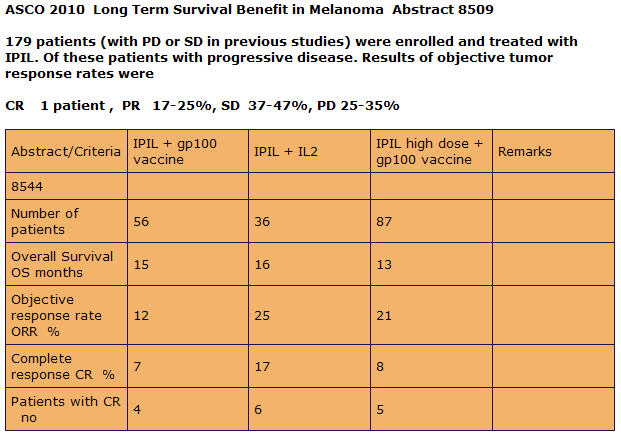
As you can see the combinatorial therapy of Anti-CTLA-4 and Interluekin-2 give the best complete response. I am convince that if they adjust the timing and dose, they will see an even higher response rate in overall survival.

The Making of an Immune Response by Combinatorial Therapy Using Anti-CTLA-4 Blockade and Interleukin-2

The paper that I am about to present to you is a culmination of research that was done base on my own experience as a stage IV Melanoma Patient. I wanted to know why my immune system responded and prove to myself and my doctors that it was not a statistical fluke. I dedicate this paper to all my fellow Melanoma Patients that lost their battle with the Beast, especially Bob Luker who fought so bravely but was unable to obtain Anti-CTLA-4 blockade due to the shortage proclaimed by Bristol Myer Squibb which halted compassionate drug use on 9-12-2008.

Most Melanoma tumors are accepted by the host’s immune system and progress even when they contain potentially antigenic proteins. This may be due to the tumor secreting immunosuppressive Cytokines like, TGF-Beta, IL-10, IL-4 and IL-6. TGF-β inhibits the proliferation and functional differentiation of T lymphocytes. TGF- Beta accelerates the expression of CTLA-4 by stimulated CD4+CD25– T cells. TGF- Beta requires CTLA-4 early after T Cell Activation to induce FoxP3 and generates adaptive CD4+CD25+ (Treg) Regulatory Cells. The tumor cells secrete TGF-Beta.

The Making of an Immune Response by Combinatorial Therapy Using Anti-CTLA-4 Blockade and Interleukin-2


“It is not the strongest of the species that survives, nor the most intelligent, but the one most responsive to change.”
~Charles Darwin~
Take Care,
Jimmy B

Photobucket

Friday, September 25, 2009

Bristol-Myers Squibb at Morgan Stanley Global Healthcare Conference 9/14/2009..Melanoma .Jim Breitfeller

Bristol-Myers Squibb at Morgan Stanley Global Healthcare Conference 9/14/2009

If you go to Bristol-Myers Squibb's website and click on investor, you will see:

Events and PresentationsBristol-Myers Squibb at Morgan Stanley Global Healthcare Conference
Monday, September 14, 2009
Webcast replay

If you sign up and play the webcast, you get the feeling that it all comes down to greed and money in my opinion. Market share, Patients, Doctors all in one breath.

Have patient become a comodity? We will vote with our feet and voices.

When they say, “What sets us apart? We believe it's our commitment to patients with serious diseases, our focus on finding innovative medicines that combat those diseases, and our dedication to extending and enhancing human life.”

All smoke and mirrors!!!!!!!

But if you listen and reach 25.55 minutes into the webcast, there is a question on Medarex and Ipilimumab. Fully human anti CTLA-4 monoclonal antibody in advanced clinical trials, Metastatic Melanoma. Phase III Data Overall Suvival data will be out shortly. With these results (I believe will be positive) in hand, I believe that Bristol-Myers Squibb (BMY) will apply for a biological licence from the FDA.

Biological products often represent the cutting edge of medical science and research. Also known as biologics, these products replicate natural substances such as enzymes, antibodies, or hormones in our bodies.

What is FDA's role regarding biological products?

FDA's regulatory authority for the approval of biologics resides in the Public Health Service Act (PHS). However, biologics are also subject to regulation under the Federal Food, Drug, and Cosmetic Act (FD&C Act) because most biological products also meet the definition of "drugs" cited within this Act.


BMY Webcast


Take Care,

Jimmy B
Photobucket

Wednesday, September 23, 2009

FDA Will Revisit Appropriate Use of PFS Endpoints at Advisory Committee..Melanoma..Jim Breitfeller

FDA Will Revisit Appropriate Use of PFS Endpoints at Advisory Committee

PFS= Pergression Free Survival

The Pink Sheet Daily. 2009 Sept 16, MJ Laffler

FDA Office of Oncology Drug Products Director Richard Pazdur plans to convene an advisory committee meeting to clarify standards for use of progression-free survival data, a move prompted by industry's aggressive adoption of the surrogate endpoint and, more broadly, the gradual decline in the level of drug benefit that sponsors seek to use in support of a cancer drug approval.

Though Pazdur wouldn't predict the timing of a meeting - beyond "soon" - he confirmed that it is an important issue that should be the topic of an upcoming meeting of the Oncologic Drugs Advisory Committee.

Industry Has Been Aggressive With PFS

In the last decade, there has been an extensive shift in oncology trials, with sponsors embracing the opportunity for earlier, arguably easier approval. The trend arose after FDA started accepting PFS as an early marker thought to be predictive of an eventual survival advantage - prompted by the urgent need for treatment options and availability of the accelerated approval pathway.

Allowing PFS to support accelerated approvals and eventually to support full approval did result in some impressive advances in medical oncology reaching patients years sooner than would have otherwise been possible. FDA has been careful to require trials to continue on in the post-market setting to demonstrate an overall survival finding, and the agency has upheld overall survival as the gold standard of efficacy evidence.

But the widespread reliance on PFS endpoints also created some sticky regulatory issues.

Source:FDA Will Revisit Appropriate Use of PFS Endpoints at Advisory Committee


As I see it, this PFS data can be used as a screening tool that shows that the drug/therapy has some response on the tumor regression/stabilization. It can be used as a predictive tool. The sooner we the patients can get our hands on the drug, the more lives may be saved. Take for instance tremelimumab and ipilimumab (Anti-CTLA-4 Blockage), it has shown great promise.

"At a meeting of cancer specialists last June Bristol-Myers and Medarex reported their drug shrank tumors in 46, or 13%, of 356 melanoma patients. The Pfizer antibody shrank melanomas in 7 of 84 patients in a midstage trial. The success rates were modest, but cancer doctors say that some patients may have had delayed responses. In some people tumors started to regress months after they had been declared treatment failures, says Bristol-Myers Vice President Renzo Canetta.

UCLA's Ribas calls the response rates "very low" and cautions that the anti-CTLA-4 drugs are just a first step. But even if the drugs improve survival only minimally, they are likely to be approved, he says.

One reason for the limited response rate may be that some patients' T cells do a poor job of recognizing melanoma. To improve this situation, researchers are combining new antimelanoma vaccines with anti-CTLA-4 drugs. The idea is that the vaccines will train T cells to spot cancer, while the antibody will make sure the T cells remain activated long enough to do their dirty work."

excerpts from FORBES.COM
Targeting Melanoma

author: Robert Langreth 10.15.07


Take Care,

Jimmy B
Photobucket

Thursday, July 23, 2009

Here is what Anti-CTLA-4 blockage can do!!!! Melanoma..Jim Breitfeller

Source:FORBES.COM

On The Cover/Top Stories

Targeting Melanoma

Robert Langreth 10.15.07, 12:00 AM ET

A new arsenal of therapies is aimed at a widespread and lethal skin cancer.


"Until recently researchers had little clue what molecular changes drive melanoma's rapid growth. But that has changed in a flurry of basic biology findings. "In terms of understanding what makes melanoma tick, in the past five years there has been an utter revolution," says Keith Flaherty, a physician at the University of Pennsylvania.

In 2002 gene researchers in the U.K. discovered that two-thirds of melanomas have a mutation in a growth-promoting gene inside skin cells called BRAF. The mutation causes the BRAF protein to become stuck in the "on" position, so it constantly sends a signal to the nucleus that it is time to proliferate. BRAF blockers are now in early-stage human trials at Novartis and separately at Roche, which works with partner Plexxikon. AstraZeneca is in midstage trials with 180 melanoma patients for a drug that hits a related target called mitogen-activated protein kinase kinase. "Every company I know of is interested in this," says Plexxikon Chief Executive Peter Hirth.

Therapies that trick the immune system into attacking melanoma are further along. Such immune system boosters have the potential to treat many types of cancer, but melanoma is one of the prime initial targets because it is one of the few cancers known to go into spontaneous remission on its own, indicating a possible immune response at work. The immune system activator interleukin-2 helps 15% of advanced melanoma cases and cures a few, but it produces such devastating side effects that patients must be hospitalized.

Pfizer's drug tremelimumab and Bristol-Myers Squibb's ipilimumab are antibodies to a protein called CTLA-4 (cytotoxic T-lymphocyte antigen-4) that acts as an emergency brake to prevent killer T cells from attacking healthy tissue. The antibodies bind to the CTLA-4, found on a cell's surface, and shut off the brake. Killer T cells then attack the cancer cells. Both drugs are in final-stage trials on hundreds of melanoma patients.

Much credit for the concept goes to immunologist James Allison, now at Sloan-Kettering. In the mid-1990s he theorized that CTLA-4 might prevent the immune system from mounting an effective response against tumors. Others were skeptical. But Allison showed in 1996 that he could shrink tumors in mice by injecting them with antibodies to CTLA-4.

Both Pfizer and Medarex, a biotech firm in Princeton, N.J., subsequently produced human antibodies to CTLA-4 and began testing them in patients a few years later. In 2005 Bristol-Myers Squibb paid Medarex $50 million in cash plus up to $480 in payments contingent on the success of Medarex's antibody.

At a meeting of cancer specialists last June Bristol-Myers and Medarex reported their drug shrank tumors in 46, or 13%, of 356 melanoma patients. The Pfizer antibody shrank melanomas in 7 of 84 patients in a midstage trial. The success rates were modest, but cancer doctors say that some patients may have had delayed responses. In some people tumors started to regress months after they had been declared treatment failures, says Bristol-Myers Vice President Renzo Canetta.

UCLA's Ribas calls the response rates "very low" and cautions that the anti-CTLA-4 drugs are just a first step. But even if the drugs improve survival only minimally, they are likely to be approved, he says. Bristol-Myers and Medarex are expected to finish key trials this fall. RBC Capital Markets analyst Jason Kantor pegged the odds of disappointing results "relatively high" in a recent report and rated Medarex an underperform; if the response rate is under 10%, it would make near-term approval "iffy", he says. Side effects of the drugs can include inflammation of the colon, thyroid or pancreas, or other autoimmune problems.

One reason for the limited response rate may be that some patients' T cells do a poor job of recognizing melanoma. To improve this situation, researchers are combining new antimelanoma vaccines with anti-CTLA-4 drugs. The idea is that the vaccines will train T cells to spot cancer, while the antibody will make sure the T cells remain activated long enough to do their dirty work.

Sharon Belvin was one of the first to try such a combination therapy. In May 2004, just a week before her wedding, she had developed a melanoma metastasis in her left lung. Belvin was only 22. The tumor grew through her chest cavity underneath her collarbone. Various chemo drugs and interleukin-2 produced nerve damage and other nasty side effects and didn't solve the problem. By June 2005 she had tumors in both lungs and could barely breathe or walk. Then Wolchok put her in a trial testing ipilimumab with an experimental Medarex vaccine. After only four treatments the tumors started to melt away. They were gone by mid-2006. The Jamesville, N.C. resident has been off therapy for a year and is pregnant with her first child, a girl due Feb. 10 2008."


By the Numbers

59,940 annual cases of melanoma in the U.S.

8,110 annual deaths.

99% five-year survival rate, localized disease.

15% five-year survival rate, widespread disease.

Source: American Cancer Society


Take Care,

Jimmy B
Photobucket

Thursday, July 9, 2009

Followup of the Anti-CTLA-4 Shortage Story..Melanoma..Jim Breitfeller

Base on this Clinical trial which is not active yet, It looks like Bristol Meyer Squibb/Medarex is trying different processes.

Comparison of Ipilimumab Manufactured by Two Different Processes in Patients With Advanced Melanoma

This study is not yet open for participant recruitment.

Verified by Bristol-Myers Squibb, June 2009
First Received: June 9, 2009 Last Updated: June 12, 2009 History of Changes
Sponsors and Collaborators: Bristol-Myers Squibb
Medarex

Information provided by: Bristol-Myers Squibb
ClinicalTrials.gov Identifier: NCT00920907

Purpose
The purpose of this clinical research study is to compare pharmacokinetics of ipilimumab manufactured by two different processes.


Condition Intervention Phase
Advanced Melanoma
Biological: Ipilimumab
Phase I

I wish they would just come out and tell the world so we would stop the speculations.

This was posted on MPIP:

"Jim! I don't believe that Medarex involve anthing to the shortage of drug in its compassionate trial.

Medarex is just a research company... not a drug manufacturing... it does not have any capacity to scale up the drug. That's a reason why they partner up with Bristol Myers for MDX-010. Because BMS is the big drug company, which already has production plans/manufacture facilities.

I do believe BMS actually ran into a shortage of production due to unexpected demands. Right now they are working on the other process production plan, which called plan B vs plan C. But the FDA still requires them to run a trial for it. See my link..

http://www.clinicaltrial.gov/ct2/show/NCT00920907?term=ipilimumab&rank=13
Comparison of Ipilimumab Manufactured by Two Different Processes


If anyone to blame for.. it's the FDA.. From the recent ASCO data, MDX-010 proves that it doubles 1 year overall survival rate, it doubles 2 years survival rate.. when compares to the history data of DTIC. But that is still not good enough to let the company market the drug? Why the FDA want to sacrifice more human lives in order to prove the drug is efficacy? The history data of DTIC, which has been studied for 30 years.. which including very recent studies ... but still not convince them. What they want.. is another trial.. 300 human lives or more in DTIC arm, and another 300 human lives in MDX-010 arm.. then to seen if 300 human lives or more in DTIC arm die sooner?

30 years since DTIC approved, NO single drug has improve overall survive.. and now the only MDX-010 has proved it.."

Thanks John for your perspective on the situation


Take Care,

Jimmy B
Photobucket

Wednesday, April 8, 2009

Carboplatin, paclitaxel, bevacizumab combination promising for stage IV melanoma.. Jim breitfeller

Carboplatin, paclitaxel, bevacizumab combination promising for stage IV melanoma

Martha Kerr
Last Updated: 2009-02-06 15:25:51 -0400 (Reuters Health)

NEW YORK (Reuters Health) - Triple therapy with monthly carboplatin, weekly paclitaxel and biweekly bevacizumab for patients with unresectable stage IV melanoma achieved "the best result ever in a clinical trial of metastatic melanoma conducted at the Mayo Clinic," investigators report.

Dr. Svetomir Markovic and colleagues in Rochester, Minnesota, conducted a two-stage phase II study of the triple chemotherapy regimen in 53 patients with unresectable stage IV melanoma. Carboplatin was given on day 1 of a 28-day cycle. Paclitaxel was given on days 1, 8 and 15. Bevacizumab was given on days 1 and 15. Treatment was continued until patients achieved remission or experienced intolerable toxicity.

The Mayo Clinic team reports in the January 1 issue of Cancer that nine patients (17%) achieved partial remission. Thirty patients (57%) achieved stable disease for at least 8 weeks.

Median progression-free survival was 6 months and median overall survival was 12 months. One patient died after eight treatment cycles from intracranial hemorrhage at the site of undiagnosed brain metastases.

Severe grade 3 or higher toxicities that limited treatment included neutropenia in 53%, thrombocytopenia in 11%, hypertension in 9% and anemia in 8%. Bevacizumab appeared to cause the most treatment-limiting toxicity, the researchers found.

"Based on our limited phase II data, the combination seems effective," Dr. Markovic said.

"An ongoing randomized Genentech-sponsored phase II study of Taxol/carboplatin compared with Taxol/carboplatin/bevacizumab in stage IV melanoma is under way," Dr. Markovic added. "If there is an advantage to the bevacizumab arm, as we would suspect, we would proceed with a randomized phase III clinical trial comparing the new combination with 'standard of care.'"

"The phase III study is already written and we will implement its final development upon release of the data from the randomized phase II study," Dr. Markovic concluded.

Cancer 2009;115:119-127.

Sourc:http://www.oncolink.org/resources/article.cfm?c=3&s=8&ss=23&id=15988&month=02&year=2009


Carboplatin, paclitaxel, bevacizumab combination promising for stage IV melanoma


Take care

Jimmy B

Tuesday, February 3, 2009

Trends in Melanoma -----Sanjiv. S. Aqarwala, MD January 29, 2009 Jim Breitfeller

Trends in Melanoma

Sanjiv. S. Aqarwala, MD
January 29, 2009

Sunbelt Melanoma Trial: Final Results
The Sunbelt Melanoma Trial, a multicenter prospective randomized trial, assessed high-dose interferon alfa-2b (IFN) or completion lymph node dissection (CLND) in the treatment of melanoma staged by sentinel lymph node (SLN) biopsy.

Eligible patients 18 to 70 years of age who had primary melanoma with Breslow thickness Ž1.0 mm underwent SLN biopsy and were assigned to one of two protocols. In protocol A, patients with a single positive lymph node after SLN biopsy and CLND were randomized to observation vs high-dose IFN (20 MU/m2/day IV 2 4 weeks followed by 10 MU/m2 /three times per week SC 2 48 weeks). Protocol B included patients with negative SLN determined by standard histopathology and immunohistochemistry. To detect melanoma-specific mRNA, these patients underwent molecular staging of the SLN by RT-PCR. Patients with RT-PCR–positive SLN were randomized to observation vs CLND vs CLND plus IFN (20 MU/m2/day IV 2 4 weeks only).

Randomization was stratified for Breslow thickness and ulceration. The primary end points were disease-free survival (DFS) and overall survival (OS). Intent-to-treat (ITT) and efficacy analyses were performed by Kaplan-Meier and Cox proportional hazards models, and the Data Safety and Monitoring Committee (DSMC) approved the final analysis.

Patients were enrolled between June 24, 1997, and October 31, 2003; median follow-up was 64 months. In the protocol A ITT analysis, there were no significant differences in DFS (HR 0.82; 95% CI, 0.47-1.40; P=0.46) or OS (HR 1.07; CI 0.65-1.78; P=0.79) for patients randomized to IFN (n=112) vs observation (n=106). In protocol B, there were no significant differences in DFS or OS among patients randomized to CLND (n=192; DFS: HR 0.72; CI 0.42-1.23; P=0.23; OS: HR 0.94; CI 0.55-1.59; P=0.81) or CLND plus IFN (n=184; DFS: HR 0.90; CI 0.54-1.50; P=0.69; OS: HR 0.96; CI 0.56-1.63; P=0.88) vs observation (n=180). The efficacy analysis did not demonstrate significant differences in DFS or OS.

This study failed to demonstrate a benefit for adjuvant high-dose IFN for patients with a single positive SLN. In addition, there was no significant benefit to CLND or CLND plus IFN among patients with melanoma cells detected in the SLN by RT-PCR analysis.

Combination Thalidomide Plus Temozolomide in a Phase II Trial in Metastatic Malignant Melanoma (MMM): SWOG S0508
After response rates up to 32% were achieved in single-institution phase II studies of thalidomide plus temozolomide as combination therapy in MMM, some clinicians have used thalidomide plus temozolomide as a standard therapy. This large multicenter phase II trial evaluated the clinical efficacy of this
therapy and the immune modulatory effects of thalidomide when combined with temozolomide in patients with MMM.

Eligible patients had cutaneous MMM proven by biopsy, no active brain metastases, Zubrod PS 0-1, no more than 1 prior systemic therapy for melanoma (excluding thalidomide, temozolomide, or dacarbazine), and adequate organ function. Six-month progression-free survival (PFS) was the primary end point; per study design, if the 6-month PFS rate was 10%, the regimen would not be of interest; if PFS was Ž25%, further study would be warranted. Response rate, OS, toxicities, and assessment of the relationship between immunologic biomarkers and clinical outcomes were secondary end points.

Patients received thalidomide (200 mg/day escalated to 400 mg/day for patients younger than 70 years, or 100 mg/day escalated to 250 mg/day for patients 70 years of age or older) plus concomitant temozolomide (75 mg/m2/day 2 6 weeks with a 2-week rest between cycles). Anticoagulation agents were not required. Treatment was continued until toxicity became unacceptable or disease progressed.

Of the 64 patients enrolled, 2 were ineligible, and 2 refused treatment. The 6-month PFS was 15% (95% CI, 6%-24%), and 1-year OS was 36% (95% CI, 24%-49%). Fifty-one patients had measurable disease by RECIST and were evaluable for response. All responses were partial, at a rate of 14% (95% CI, 6%-26%). One treatment-related death occurred due to MI. Three grade 4 events occurred: one case each of PE, neutropenia, and CNS ischemia; fatigue was the most common of 21 grade 3 events. Immunologic biomarkers were obtained at baseline and at 5, 9, and 13 weeks, including PBMC as a percentage and as an absolute count of CD4+/CD25+/CD69+ and CD16+/CD56+ cells, and ELISPOT reactivity to a recall pool of antigens.

Thalidomide plus temozolomide has little additional clinically meaningful activity compared with temozolomide alone in MMM. In a meta-analysis of systemic therapy for MMM, thalidomide plus temozolomide compared poorly. This regimen should not be considered a standard treatment for MMM.
Clark J, et al. J Clin Oncol. 2008;26(May 20 suppl). Abstract 9007

Unresectable Metastatic Melanoma: A Phase II Clinical Trial With a Second-Generation GM-CSF–
Encoding Oncolytic Herpesvirus
OncoVEX (GM-CSF) is a second-generation oncolytic herpes simplex virus that encodes granulocyte-macrophage colony-stimulating factor (GM-CSF). In a phase I trial, it was well tolerated in patients with several types of tumors, and antitumor effects were seen in both injected and uninjected tumors.
Patients eligible for this phase II trial had unresectable stage IIIc/IV melanoma with Ž1 injectable tumor (ultrasound allowed) and had failed prior therapy. Patients with clinically active brain, liver, or bone metastases were excluded. Fewer than 10 lesions were to be injected, and more than 1 lesion was to be left uninjected. The dosing schedule consisted of one injection of 4 mL of 106 plaque forming units (pfu)/mL split between target tumors, followed 3 weeks later by 24 injections of 108 pfu/mL every 2 weeks. The study was designed to assess single-arm monotherapy in up to 50 evaluable patients, and more than one RECIST response among the first 24 patients was required to continue the trial. Response rate was the primary end point; safety, response kinetics, and survival were secondary end points.

At the time of this report, the study had enrolled 40 patients, 31 of whom were evaluable. Patients had up to 18 injection cycles. By 2 months on therapy, injected tumors routinely responded, often with local complete response (CR); often, palliative benefit was also achieved. Systemic responses included: 3 patients with CR, 3 with partial response (PR), 4 with durable stable disease (SD), and 2 with mixed response (ŽPR of existing disease and ŽPR of lesions, which later became measurable); 2 patients had posttreatment objective responses. Patients with both stage IIIc and IV disease achieved systemic responses, including resolution of visceral disease. Systemic responses are delayed since injected tumor responses take up to 10 months to fully develop. All objective responses have been maintained to date at 4 to 23 months after the first dose, with those patients not achieving CR still on therapy. Side effects have been grade 1 flu-like symptoms.

Data show that 32% of patients achieved CR, PR, or durable SD. Other patients also experienced clinical benefit: 2 patients had response in tumors that were first noted during therapy; 2 patients responded after leaving the study due to progressive disease; additional patients experienced local palliative benefit in otherwise difficult-to-treat tumors. The rate and durability of response is considered impressive compared with other treatments for advanced melanoma, particularly in the second-line/salvage therapy setting, and further evaluation is therefore warranted.

Tremelimumab and Temozolomide or Dacarbazine: A Phase III, Open-Label, Randomized, Comparative Study in Patients With Advanced Melanoma
This phase III study compared OS achieved with tremelimumab, a fully human anticytotoxic T lymphocyte–associated antigen 4 monoclonal antibody, with OS achieved with standard, single-agent chemotherapy.
Eligible patients had unresectable stage IIIc/IV melanoma without brain metastasis, LDH below 2 2 ULN, and no prior systemic treatment for advanced melanoma. Patients were randomized 1:1 to either tremelimumab 15 mg/kg IV every 90 days, or physician's choice of temozolomide 200 mg/m2 po on days 1-5 every 28 days or dacarbazine 1000 mg/m2 IV every 21 days (chemotherapy arm). Primary end point was OS, and secondary end points included response, durable tumor response, 6-month PFS, and safety. Two equally spaced interim analyses were planned based on the group sequential design using the Lan-DeMets alpha and beta spending approach to an O'Brien-Fleming boundary.

Between March 2006 and July 2007, 655 patients enrolled, with 328 patients randomized to tremelimumab (324 treated) and 327 to chemotherapy (319 treated). Significant imbalances were not noted in age, sex, LDH, or disease stage (5% stage IIIc, 15% M1a, 22% M1b, 58% M1c). The most common treatment-related adverse events in the tremelimumab arm were diarrhea (43% overall, 14% grade 3/4), pruritus (25%), and rash (23%). Pituitary or adrenal gland toxicities occurred in 3% of patients, and thyroid toxicities in 4%. There were three treatment-related deaths in the tremelimumab arm but none in the chemotherapy arm.

The independent DSMC advised researchers to end the study on March 28, 2008, because the log-rank test-statistic (P=0.729) had crossed the O'Brien-Fleming futility boundary based on a protocol-specified second interim analysis that reported 340 deaths. The ITT median OS was 11.8 months (95% CI, 10.4-13.9) in the tremelimumab arm and 10.7 months (95% CI, 9.3-12.0) in the chemotherapy arm, with a HR (chemotherapy over tremelimumab) of 1.04 (95% CI, 0.84-1.28).

Tremelimumab as a single agent failed to demonstrate an improvement in OS as a first-line treatment in patients with metastatic melanoma when compared with standard chemotherapy. Analysis of the secondary end points may yield additional information.

Ribas A, et al. J Clin Oncol. 2008;26(May 20 suppl). Abstract LBA9011.
Tuesday, January 27, 2009

Latest survival data from three Phase II ipilimumab studies!!!!! Melanoma ..Jim Breitfeller

Latest survival data from three Phase II ipilimumab studies showed almost half of previously treated metastatic melanoma patients alive beyond one year1,2,3

- Data presented at the 33rd Congress of the European Society for Medical Oncology -


Stockholm – 16 September 2008 – Bristol-Myers Squibb announced updated survival data from three Phase II studies of ipilimumab in patients with advanced metastatic melanoma (Stage III or IV), which showed that approximately half of previously-treated patients who received ipilimumab (10 mg/kg) remained alive beyond one year. 1,2,3 Ipilimumab is designed to block the activity of CTLA-4 (a molecule on T-cells that plays a critical role in regulating natural immune responses), and thereby activates the immune system to fight metastatic melanoma.4,5

The results are based on a follow-up of the patient population from studies 008, 022 and 007. 47 – 51 percent of patients with advanced metastatic melanoma treated with 10 mg/kg of ipilimumab (induction and maintenance) showed a consistent survival rate of one-year.1,2,3 Specifically, the results show:

* 47 percent of patients who had progressed while on or after receiving standard treatment achieved one year survival (Study 008)1

* 48 percent of patients who were previously treated, relapsed or failed to respond to experimental treatment or were unable to tolerate currently approved therapies achieved one-year survival (Study 022)2

* 51 percent of patients previously treated with therapy other than ipilimumab achieved one year survival (Study 007)3

Recent medical literature, based on a meta-analysis of 42 Phase II trials with 2,100 patients, reported a one-year survival rate of approximately 25.5 percent for patients with Stage III or IV metastatic melanoma, the most advanced type of the disease.6

http://www.countrydoctor.co.uk/education/Education%20-%20Metastatic%20melanoma%20hopes.htm

Jimmy B

Tuesday, January 20, 2009

Call for Patients!!!!!!! NEW CLINICAL TRIAL!!!!!!!!

Jim

We have powerful new immunotherapy treatments for patients with metastatic melanoma using cell transfer techniques (see attached publication).

Our latest treatment has a 72% objective response rate with 36% complete responses.

We are currently recruiting patients for our latest trial.


Is there some way to post this “Call for Patients” on the web site?

Steve Rosenberg

Steven A. Rosenberg M.D., Ph.D.

Chief, Surgery Branch
National Cancer Institute
10 Center Drive MSC 1201
CRC Room 3-3940
Bethesda, MD 20892

301-496-4164

sar@nih.gov

Adoptive Cell Therapy for Patients With Metastatic Melanoma: Evaluation of Intensive Myeloablative Chemoradiation Preparative Regimens


Mark E. Dudley, James C. Yang, Richard Sherry, Marybeth S. Hughes, Richard Royal, Udai Kammula,
Paul F. Robbins, JianPing Huang, Deborah E. Citrin, Susan F. Leitman, John Wunderlich, Nicholas P. Restifo,
Armen Thomasian, Stephanie G. Downey, Franz O. Smith, Jacob Klapper, Kathleen Morton,
Carolyn Laurencot, Donald E. White, and Steven A. Rosenberg


Purpose
The two approved treatments for patients with metastatic melanoma, interleukin (IL)-2 and dacarbazine, mediate objective response rates of 12% to 15%. We previously reported that adoptive cell therapy (ACT) with autologous antitumor lymphocytes in lymphodepleted hosts mediated objective responses in 51% of 35 patients. Here, we update that study and evaluate the safety and efficacy of two increased-intensity myeloablative lymphodepleting regimens.

Patients and Method

We performed two additional sequential trials of ACT with autologous tumor-infiltrating lymphocytes (TIL) in patients with metastatic melanoma. Increasing intensity of host preparative lymphodepletion consisting of cyclophosphamide and fludarabine with either 2 (25 patients) or 12 Gy (25 patients) of total-body irradiation (TBI) was administered before cell transfer. Objective
response rates by Response Evaluation Criteria in Solid Tumors (RECIST) and survival were evaluated. Immunologic correlates of effective treatment were studied.

Results

Although nonmyeloablative chemotherapy alone showed an objective response rate of 49%,
when 2 or 12 Gy of TBI was added, the response rates were 52% and 72% respectively.
Responses were seen in all visceral sites including brain. There was one treatment-related death in the 93 patients. Host lymphodepletion was associated with increased serum levels of the lymphocyte homeostatic cytokines IL-7 and IL-15. Objective responses were correlated with the telomere length of the transferred cells.


Conclusion

Host lymphodepletion followed by autologous TIL transfer and IL-2 results in objective responserates of 50% to 70% in patients with metastatic melanoma refractory to standard therapies.

J Clin Oncol 26:5233-5239. Published by the American Society of Clinical Oncology

The paper is upload in my shared files : (see Shared Files)

Dudley JCO '08 Adoptive Cell Therapy for Patients With Metastatic

Friday, January 16, 2009

I Thought I was the Only ONE Seeing This Trend!! Melanoma Jim Breitfeller

Sorry, I tried to catch up on some reading and this was in the pile.
I thought it could not wait. I am Vindicated!!!!

Promising immunotherapeutic approaches to the treatment of metastatic melanoma: modulation of the immune response

Mario Sznol, MD

Yale Cancer Center, New Haven, CT

Durable remissions of advanced unresectable melanoma can be achieved in a small fraction of patients with immune-based therapy, such as high-dose interleukin-2 (IL-2). Based on an increased understanding of normal and pathologic immune responses at the molecular level and the specific interactions between growing tumors and the host immune response, new approaches to cancer immunotherapy are emerging. Optimism for advances in the immunotherapy of melanoma comes from new agents and approaches that specifically target and modify the regulators of T-cell proliferation, survival and effector function, and/or block tumor-related immunosuppressive mechanisms. One of these agents, anti-CTLA4 (anti-cytotoxic T-lymphocyte–associated antigen 4), has shown the ability to produce durable responses in patients with metastatic melanoma, including some previously unresponsive to IL-2. Preclinical studies indicate that even stronger antitumor immune responses can evolve when agents are combined rationally.

Promising immunotherapeutic approaches to the treatment of metastatic melanoma: modulation of the immune response


I shouted FIRE and no one came. Well, now there is two of us Shouting!!!!!


Jimmy B

Greetings to One and All

This Blog is dedicated My Brother Kenny B. who passed away in the late 1970's with Cancer before the Internet.

It was he, who showed me How to live and give back. He was wise beyond his years.


Kenny B


Jimmy and Dee

Carepage: Jimmybreitfeller
Jimmy Breitfeller


My Profile as of 2009

My photo
Last July (2005)I was riding my bicycle to work at the Eastman Kodak Research Labs about 3 miles from home. I was wearing a knapsack to carry my things to and from the labs. I started noticing an ache on my back. So I decide to go to the dermatologist. To make the long story short, it was cancer. I knew from my research that I would be needing adjuvant therapy. So I started communicating with Sloan Kettering, University of Pittsburgh Cancer Center, and a couple of others including the Wilmot Cancer Center at Strong. I realized that by telling my story, I might help someone else out there in a similar situation. So to all who are linked by diagnosis or by relation to someone with melanoma, I wish you well. Stay positive, read as much as you can (information helps to eliminate the fear associated with the unknown), and live for today, as no one can predict what tomorrow may bring. Jimmy B. posted 12/15/08

Disclaimer

The information contained within this Blog is not meant to replace the examination or advice of your Oncologist or Medical Team. The educational material that is covered here or Linked to, does not cover every detail of each disorder discussed.

Only your physician/Oncologist can make medical decisions and treatment plans that are appropriate for you. But, An Educated Consumer is a Smart consumer.

As Dr. Casey Culberson Said:

"The BEST melanoma patient is an ACTIVE PARTICIPANT in his or her treatment
(not a PASSIVE RECIPIENT)"

Melanoma and the “Magic Bullet” (Monoclonal Antibodies)

Just to let you know I posted the first draft of the Melanoma and the “Magic Bullet” (Monoclonal Antibodies). on Melanoma Missionary In the Shared File Section. you can download it for 19.95 (Only kidding) it is Free for the taking.


It is 33 pages long and may help you in your quest for the Yellow Brick Broad. Just to let you know it is only the first draft. Revisions are sure to come. I wanted to get it to the people that need it the most, the Melanoma Patients.

Preview:

So, where does Interluekin-2 (IL-2) come into play? According to Byung-Scok et al and recent reports, IL-2 is not needed for developmental CD4+ CD25+ Treg cells in the thymus but does play an important role in the maintenance and function in the peripheral.18 Peripheral is defines as secondary system outside the bone marrow and thymus. It entails the site of antigen, immune system interaction. IL-2 is required for the peripheral generation of Tregs based Abbas’s and colleagues research.19

IL-2 prevents the spontaneous apoptosis of the CD4+ CD25+ Treg cells. It has been reported that patients with multiple advance-stage tumors have elevated levels of Tregs within the tumor microenviroment.20 Interluekin-2 is the survival factor for CD4+ CD25+ Treg cells.21 If the addition of IL-2 is on or before the maximum propagation of the CD4+ T cells, the Tregs population can increase 5-fold in a 96 hour period based on certain growth mediums.

By controlling the addition of the endogenous IL-2, one has a knob to turn and can lead to the control of the expansion of the Tregs. When you combined this control with the anti-CTLA-4 blockage, you can shift the balance of the immune response.

Now here is the catch. The maintenance and function of the CD8+ T-cells require CD4+ cells which secrete IL-2. So we don’t want to deplete the CD4+ cells, we want to control the expansion of the Tregs which are a subset of the CD4+ cells. It has been postulated by some researchers that the Anti-CTLA-4 blockage also suppresses the Treg function in a different mechanism. By using IL-2 as the rate limiting factor, we can suppress the CD4+ CD25+ Treg cell expansion by controlling the concentration and timing of the Inerluekin-2 at the tumor microenvironment.


The Interluekin-2 plays another role in this Melanoma Maze. In a study by Janas et al, Il-2 increases the expressions of the perforin and granzyme A, B and C genes in the CD8+ T-cells. This increase expression causes the CD8+ T-cells to mature into Cytoxic T Lymphocytes (CTLs). The exogenous IL-2 is required for the granzyme proteins. As stated previously, CTLs have cytoplasmic granules that contain the proteins perforin and granzymes. A dozen or more perforin molecules insert themselves into the plasma membrane of target cells forming a pore that enables granzymes to enter the cell. Once in the tumor cell, these enzymes are able to breakup (lyse) the cell and destroy it. This is the beginning of the end for the cancer cells. The tumors begin to shrink and the rest is history,


On the other hand, prolong therapy with Il-2 can result in causing apoptotic death of the tumor- specific CD8+ T-cells.23

Clearly in a clinical setting, timing, dose, and exposure to these drugs play a major roll in the immunotherapy, and can have dramatic effects on the outcome.

All it takes is that one magic bullet to start the immune reaction..

https://app.box.com/shared/kjgr6dkztj

Melanoma And The Magic Bullet (Monoclonal Antibodies)

Public Service Announcement

A call for Melanoma Patients by Dr. Steven A Rosenberg

"We continue to see a high rate of clinical responses in our cell transfer immunotherapy treatments for patients with metastatic melanoma", Dr. Rosenberg said.

"We are actively seeking patients for these trials and any note of that on a patient-directed web site would be appreciated."

If you would like to apply for his trials, here is the website and information.

Dr. Rosenberg's information


Dr. Rosenberg's Clinical Trials


For the Warriors


The Melanoma Research Alliance has partnered with Bruce Springsteen, the E Street Band, and the Federici family to alleviate suffering and death from melanoma. Please view Bruce Springsteen’s public service announcement inspired by Danny Federici. Danny was the E Street Band’s organist and keyboard player. He died on April 17, 2008 at Memorial Sloan-Kettering Cancer Center in New York City after a three year battle with melanoma.


http://www.melanomaresearchalliance.org/news/PSA/

Source Fastcures blog


Join the Relay for Life!!!

Photobucket

Dear Family and Friends,

I’ve decided to take a stand and fight back against cancer by participating in the American Cancer Society Relay For Life® event right here in my community! Please support me in this important cause by making a secure, tax-deductible donation online using the link below.

To donate on line now, click here to visit my personal page.
Jimmy B AKA Melanoma_Missionary

Relay For Life® is a life-changing event that brings together more than 3.5 million people worldwide to:

CELEBRATE the lives of those who have battled cancer. The strength of survivors inspires others to continue to fight.

REMEMBER loved ones lost to the disease. At Relay, people who have walked alongside people battling cancer can grieve and find healing.

FIGHT BACK. We Relay because we have been touched by cancer and desperately want to put an end to the disease.

Whatever you can give will help - it all adds up! I greatly appreciate your support and will keep you posted on my progress.

Keep the Fire Burning!!!

Photobucket

Sincerely,

Jimmy Breitfeller
Turn off Music before you "Click to Play"
Signs of Melanoma Carcinoma Skin Cancer

How Skin Cancer Develops by "About.com : Dermatology"

Call for Patients with Unresectable Liver Metastases Due to Melanoma


Delcath Systems Granted Orphan-Drug Designations for Cutaneous and Ocular Melanoma


Delcath is actively enrolling patients in a Phase III clinical trial testing its proprietary drug delivery system, known as Percutaneous Hepatic Perfusion (“PHP”), with melphalan for the treatment of ocular and cutaneous melanoma metastatic to the liver.

This NCI-led trial is enrolling patients at leading cancer centers throughout the United States. Commenting on these orphan-drug designations, Richard L. Taney, President and CEO of Delcath, stated, “These favorable designations are important steps in our efforts to secure Delcath’s commercial position upon conclusion of our pivotal Phase III trial for metastatic melanoma. We remain steadfast in our commitment to become the leader in the regional treatment of liver cancers and we continue to enroll patients in this study, and advance our technology and the promise that it offers to patients with these deadly forms of melanoma and other cancers of the liver, all with limited treatment options.”

Orphan drug designation, when granted by the FDA’s Office of Orphan Products Development, allows for up to seven years of market exclusivity upon FDA approval, as well as clinical study incentives, study design assistance, waivers of certain FDA user fees, and potential tax credits.


Current Trial Centers


Phase I Study of Hepatic Arterial Melphalan Infusion and Hepatic Venous Hemofiltration Using
Percutaneously Placed Catheters in Patients With Unresectable Hepatic Malignancies


James F. Pingpank, Jr., MD, FACS
Associate Professor of Surgery
Division of Surgical Oncology
Suite 406, UPMC Cancer Pavillion
5150 Centre Avenue
Pittsburgh, PA 15232
412-692-2852 (Office)
412-692-2520 (Fax)
PingpankJF@UPMC.edu


Blog Archive

Call For Melanoma Patients!!!!

Call For Melanoma Patients!!!!

Dr. Rosenberg Has a New Clinical Trial.

Our latest treatment has a 72% objective response rate with 36% complete responses.

We are currently recruiting patients for our latest trial.

Is there some way to post this “Call for Patients” on the web site?

Steve Rosenberg

Dr. Rosenberg's Clinical Trials


(For a copy of the research paper.. see My Shared files)

The news headlines shown above for Melanoma / Skin Cancer are provided courtesy of Medical News Today.