Showing posts with label asco. Show all posts

Monday, January 7, 2013

ASCO 2013.. The comming out party for Combination Therapy!!! Yervoy + Anti-PD-1 ..Melanoma. Jim Breitfeller

ASCO 2012 was PD-1’s debutant ball, but we may have found a partner (Yervoy) at this Year’s 2013 Ball and may be only a few years away from its coronation (FDA’s approval) as a stand alone or combinatorial therapy. I believe that ASCO 2013 will be the coming out party for combination therapy of Anti-PD-1 + Yervoy.

br />
Using this combination blocks two checkpoint pathways on the T-Cells leaving it activated to proliferate and destroy the cancer.


If you add Yervoy & Anti-PD-1 to the therapy you have a better chance to activate the CD4 and CD8 T-cells


“It is not the strongest of the species that survives, nor the most intelligent, but the one most responsive to change.”
~Charles Darwin~
Take Care,

Jimmy B

 Photobucket

Wednesday, July 4, 2012

Interview With Michael B. Atkins, MD Immunotherapies in Melanoma.Jim Breitfeller

Interview With Michael B. Atkins, MD Immunotherapies in Melanoma: Taking Stock
 Alice Goodman, MA; Michael B. Atkins, MD

 Posted: 07/02/2012

 Editor's Note: Immunotherapy is the only treatment that can produce durable tumor regression in patients with metastatic melanoma. With novel molecularly targeted agents also being developed for metastatic melanoma, the hope is to learn how to combine and sequence these therapies and improve survival for patients with this once universally fatal disease. At the 2012 annual meeting of the American Society of Clinical Oncology (ASCO®), Dr. Michael B. Atkins, Deputy Director of the Georgetown Lombardi Comprehensive Cancer Center in Washington, DC, chaired an educational session on immunotherapy in advanced melanoma.

 Medscape caught up with Dr. Atkins to ask him to put into perspective the emerging data on immunotherapy and what questions still need to be answered.

IL-2 Opens the Door Medscape:
 What was the first immunotherapy to show an effect in metastatic melanoma?

Dr. Atkins: High-dose interleukin (IL)-2 received US Food and Drug Administration (FDA) approval for the treatment of patients with metastatic melanoma in 1998. A number of durable responses were observed and 11% of patients were alive at 5 years.[1] More recent studies have shown that patients with elevated lactate dehydrogenase (LDH) levels are much less likely to respond to IL-2, with about a 6% response rate in patients with elevated LDH (all partial responses) and about 21% in those with normal LDH levels.[2] Analysis of molecular profiles shows that a significantly larger proportion of patients with BRAF- and NRAS-mutated tumors respond to IL-2 than those who do not have these mutations. Also, we now have information suggesting that tumors with an inflamed phenotype and immune infiltrates have a 2- to 3-fold improved chance of response relative to those with a noninflamed gene expression pattern.

Michael B. Atkins, MD
Medscape: Has IL-2 been combined with other immunotherapies?

Dr. Atkins:
 IL-2 has been combined with vaccine therapy. Results of a randomized trial found that the combination of IL-2 plus vaccine produced response rates of 22.1% compared with 9.7% with IL-2 alone, and a trend was observed toward improved overall survival.[3] Median survival was 17.6 months with the combination of IL-2 plus vaccine vs 12.8 months with IL-2 alone. Very few relapses were seen beyond 2 years in responding patients, a hallmark of effective immunotherapy. However, lower-than-expected response rates were reported for the IL-2-alone group, calling into question how much of an advance this treatment is. Some questions remain: Is this a proof of concept that the immune response can be focused by a vaccine? Will the findings be relevant with novel immunotherapies? Ipilimumab: A Check-Plus for a Checkpoint Inhibitor Medscape: More recently, ipilimumab, a different type of immunotherapy, was approved by the FDA for the treatment of metastatic melanoma. This drug is referred to as the first checkpoint inhibitor, meaning that it interferes with an important downregulatory property of the immune response.

How does this drug work, and what kinds of outcomes does it achieve?

Dr Atkins: The monoclonal antibody ipilimumab blocks CTLA-4, which serves as a coregulatory protein that shuts off the immune response when it binds to a protein on antigen-presenting cells. Blocking CTLA-4 restores immunity. Ipilimumab has been evaluated in a variety of clinical trials. It is administered intravenously once every 3 weeks for 4 doses on an outpatient basis. Its side effects result primarily from induction of immune reactions against normal tissues, but in general, it produces fewer inflammatory systems (eg, fever, chills, hypotension) than those associated with high-dose IL-2. A recent trial compared ipilimumab plus gp100 vaccine vs ipilimumab alone vs the vaccine alone.[4] In both ipilimumab-containing arms, survival was prolonged. One-year survival was 46%, 44%, and 26% for the 3 arms, respectively. Two-year survival was 22%, 24%, and 14%. Few deaths occurred in the ipilimumab-treated patients after 30 months.

Medscape: What about the safety profile of ipilimumab and patient selection?

Dr Atkins:
The toxicities of ipilimumab are related to activation of the immune system and include colitis, dermatitis, endocrine effects, and hepatitis. In clinical trials, all subgroups benefitted from ipilimumab, with the possible exception of patients with elevated LDH. One feature of ipilimumab is apparent disease progression early in the course of treatment followed by a major response, so we have learned that the effect of treatment is not seen immediately. Pooled data from clinical trials suggest that about 25% of patients with metastatic melanoma have long-term benefit from ipilimumab therapy, and the benefit might be greater with a higher dose of the drug. Also, there is a potential role for maintenance therapy with this agent.

Medscape: Has ipilimumab been studied in combination therapy?

Dr Atkins:
A study was conducted in previously untreated patients with metastatic melanoma in which the patients were randomly assigned to dacarbazine alone or dacarbazine plus ipilimumab.[5] Some experts expected better results than were achieved in this first-line setting, and it is possible that dacarbazine may have compromised outcomes.

Medscape: What are the take-home messages about ipilimumab for metastatic melanoma?

Dr. Atkins:
Ipilimumab enables an immune response and antitumor responses in some individuals. This agent is powerful enough to work in the central nervous system and overcome concurrent immunosuppression. The response to ipilimumab may be associated with autoimmunity. Activity of the drug is seen in patients previously treated with IL-2. This drug is an option for most patients with advanced melanoma. Optimal timing of therapy and severe autoimmune toxicities should be considered. We don't know the answers to all of the questions about how to use ipilimumab. Should it be combined with dacarbazine? Should it be used as first-line or second-line treatment? What is the optimal dose and schedule? Does it have a role in maintenance therapy? What is its role in the adjuvant setting? What combinations should be studied? Some possible combination partners are bevacizumab, GM-CSF [granulocyte-macrophage colony-stimulating factor], high-dose IL-2, and the novel PD-1 antibody. PD-1 Inhibitor: New Kid on the Block Medscape: At the 2012 annual meeting of ASCO®, we heard exciting preliminary reports about a second checkpoint inhibitor called MDX-1106, a PD-1 antibody.

 How does this immunotherapy work, and what are preliminary observations?

 Dr. Atkins:
On activated T-cells, PD-1 serves as the receptor for PD-L1, which is expressed on tumor cells. When PD-L1 binds to PD-1 inside the tumor microenvironment, it paralyzes T-cell immune function. Blocking the interaction between PD-L1 and PD-1 with an antibody provides a specific way to activate the immune system within the tumor microenvironment. It is hypothesized that this would provide a less toxic and more potent means of activating the immune system. Several presentations at ASCO® on this novel immunotherapy showed exciting preliminary results. A large phase 1 study evaluated MDX-1106 given every 2 weeks for up to 2 years in patients with melanoma, renal, and non-small cell lung cancer.[6] Durable responses were seen in all 3 malignancies. In the melanoma patients, about half had tumor shrinkage and some responses were quite significant. This novel therapy will move forward in clinical development for patients with melanoma, either as a single agent or in combination. A number of PD-1 and PDL-1 blockers are under development. Which Patients Are Right for Immunotherapy?

Medscape: How do you select patients for treatment with immunotherapy?

 Dr Atkins: Patients with metastatic melanoma are not all the same. There are 2 basic phenotypes: noninflamed and inflamed. Data suggest that the second phenotype is associated with a better prognosis; that is, the greater the percentage of immune cells within a tumor, particularly CD8+ T cells, the better the prognosis. As mentioned previously, patients with tumors expressing an immune signature are more likely to respond and to exhibit a longer progression-free survival than those with tumors that do not have this signature. Studies suggest that PDL-1 expression appears to be associated with benefit, because patients without PD-L1 expression were less likely to respond to PD-1 antibody.[6-8] Sequencing: Which Therapy, and When? Medscape: What is the current thinking on sequencing of therapies? Dr Atkins: In addition to immunotherapies, several new targeted therapies are on the horizon. Vemurafenib, which targets tumor containing a BRAF V600E mutation, is approved for the treatment of patients with metastatic melanoma, and other BRAF and MEK inhibitors are being studied. These therapies may be able to be used in combination with immune therapies to improve outcomes. Most patients would like a chance to be cured. Immune therapies are the only curative therapies for advanced melanomas. Thus, if patients can receive an immune therapy, it may be better to give it first. For BRAF wild-type tumors (those without the BRAF V600E mutation) and even for the BRAF-mutated tumors, it might make sense to give patients an immunotherapy first to try to produce long-term benefit and reserve the use of a BRAF inhibitor for those patients who don't respond to immunotherapy. Data suggest that giving an immunotherapy first does not reduce the ability to respond to a BRAF inhibitor. On the other hand, patients who progress on vemurafenib do not appear to respond to ipilimumab. In fact, in a small study of 32 patients whose disease progresses on vemurafenib, 50% were dead within 4 months.[9] Only 3 of the 32 patients were alive longer than 1 year, and all of them were back on a BRAF or a MEK inhibitor. These preliminary data suggest that a BRAF inhibitor may not be the best initial therapy for some, if not most, patients with BRAF V600E mutations. A prospective trial is needed to study this question. A sequencing study is being planned by ECOG that has 2 arms: ipilimumab with crossover to vemurafenib at time of progression vs vemurafenib with crossover to ipilimumab at time of progression. The primary endpoint will be overall survival at 2 years. The study should tell us which is the best initial therapy for patients with BRAF mutant metastatic melanoma.

More Work to Be Done Medscape: Are there any potential downsides to combining immunotherapy and targeted therapy?

Dr Atkins: By combining immunotherapy and targeted therapy, the hope is to get the benefits of both worlds. But there are potential problems. Studies suggest that dacarbazine interferes with the immune effects of ipilimumab; however, preliminary data suggest that BRAF inhibitors might increase immune infiltration into tumors, converting the microenvironment from a noninflamed state to an inflamed state. Theoretically, this might mean that the combination of a BRAF inhibitor with immunotherapy might produce synergistic antitumor benefits. Medscape: What can you say to sum up where we are with melanoma immunotherapy in 2012? Dr Atkins: We have IL-2 and ipilimumab, and there are novel immunotherapies on the horizon, including the PD-1 antibody. We will need studies to refine optimal patient selection and identify the best combination treatments, including a BRAF inhibitor either alone or in combination with MEK inhibitors. The field has advanced, and in 2012 it is no longer futile to treat metastatic melanoma. There is a glimmer of hope on the horizon, but there is still a lot of work to be done.

Source: http://www.medscape.com/viewarticle/766473?src=mp&spon=38

“It is not the strongest of the species that survives, nor the most intelligent, but the one most responsive to change.”

~Charles Darwin~

Take Care,

Jimmy B

 Photobucket

Saturday, June 2, 2012

Promising New Approach To Treating Cancer Means Hope For Many, But Remember This Is Just The Start Of The Journey..Melanoma ..Jim Breitfeller

Promising New Approach To Treating Cancer Means Hope For Many, But Remember This Is Just The Start Of The Journey

http://www.cancer.org/AboutUs/DrLensBlog/post/2012/06/02/Promising-New-Approach-To-Treating-Cancer-Means-Hope-For-Many-But-Remember-This-Is-Just-The-Start-Of-The-Journey.aspx


A while back , in 2011 I wrote about combinatorial therapy as the way to form a curative therapy for melanoma.See blog entry "“Schedule and Dose for Combination Therapy,”


It is now just starting to gain acceptance in the oncology world ASCO 2012. You need to block multiple pathways to shutdown the tumor's ability to side-step the immune system.If you search on my blog using the search field, you will be able to follow the science.


“It is not the strongest of the species that survives, nor the most intelligent, but the one most responsive to change.”

~Charles Darwin~

Take Care,

Jimmy B
 Photobucket

Tuesday, June 14, 2011

2011 ASCO Annual Meeting Highlights on Melanoma and Neuroblastoma, with Lynn Schuchter, MD ..jim breitfeller

2011 ASCO Annual Meeting Highlights on Melanoma and Neuroblastoma, with Lynn Schuchter, MD
June 5, 2011

2011 ASCO Annual Meeting Highlights on Melanoma and Neuroblastoma, with Lynn Schuchter, MD


“It is not the strongest of the species that survives, nor the most intelligent, but the one most responsive to change.”

~Charles Darwin~

Take Care,

Jimmy B

Photobucket

Tuesday, October 12, 2010

ASCO 2010 Long Term Survival Benefit in Melanoma...Jim Breitfeller


As you can see the combinatorial therapy of Anti-CTLA-4 and Interluekin-2 give the best complete response. I am convince that if they adjust the timing and dose, they will see an even higher response rate in overall survival.

The Making of an Immune Response by Combinatorial Therapy Using Anti-CTLA-4 Blockade and Interleukin-2

The paper that I am about to present to you is a culmination of research that was done base on my own experience as a stage IV Melanoma Patient. I wanted to know why my immune system responded and prove to myself and my doctors that it was not a statistical fluke. I dedicate this paper to all my fellow Melanoma Patients that lost their battle with the Beast, especially Bob Luker who fought so bravely but was unable to obtain Anti-CTLA-4 blockade due to the shortage proclaimed by Bristol Myer Squibb which halted compassionate drug use on 9-12-2008.

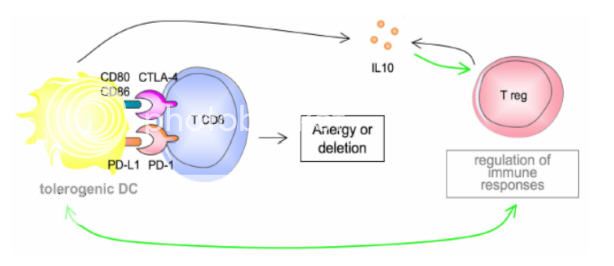
Most Melanoma tumors are accepted by the host’s immune system and progress even when they contain potentially antigenic proteins. This may be due to the tumor secreting immunosuppressive Cytokines like, TGF-Beta, IL-10, IL-4 and IL-6. TGF-β inhibits the proliferation and functional differentiation of T lymphocytes. TGF- Beta accelerates the expression of CTLA-4 by stimulated CD4+CD25– T cells. TGF- Beta requires CTLA-4 early after T Cell Activation to induce FoxP3 and generates adaptive CD4+CD25+ (Treg) Regulatory Cells. The tumor cells secrete TGF-Beta.

The Making of an Immune Response by Combinatorial Therapy Using Anti-CTLA-4 Blockade and Interleukin-2


“It is not the strongest of the species that survives, nor the most intelligent, but the one most responsive to change.”
~Charles Darwin~
Take Care,
Jimmy B

Photobucket

Wednesday, August 18, 2010

Understanding Cancer Vaccines

Source: http://www.cancer.net/patient/All+About+Cancer/Cancer.Net+Feature+Articles/Treatments,+Tests,+and+Procedures/Understanding+Cancer+Vaccines

I know some of you are doing or are looking into Cancer Vaccines. This may help you.

Understanding Cancer Vaccines

A vaccine helps the body fight disease. Most people are familiar with vaccines for diseases like chicken pox or the flu. Vaccines (sometimes called vaccinations) help train the immune system to recognize and destroy harmful substances, such as bacteria or viruses, before they can cause disease.

There are two types of cancer vaccines: prevention vaccines and treatment vaccines. A prevention vaccine is given to a healthy person to prevent the development of a specific type of cancer. The U.S. Food and Drug Administration (FDA) has approved three vaccines for cancer prevention. Gardasil and Cervarix are two different vaccines that prevent infection with the human papillomavirus (HPV). A long-lasting infection with HPV can cause cervical cancer. (HPV is also thought to cause other types of cancer, but so far, the vaccine is only approved for cervical cancer.) The third approved vaccine prevents infection with the hepatitis B virus (HBV); long-term infection with HBV can lead to the development of liver cancer.

A cancer treatment vaccine is a type of immunotherapy. Immunotherapy, also called biologic therapy, helps the body’s immune system fight the cancer. A treatment vaccine may prevent cancer from coming back, destroy any remaining cancer cells after other types of treatment, or stop cancer cell growth. A cancer vaccine is designed to be specific, which means it is supposed to get rid of the cancerous cells and not the healthy cells. Most vaccines for cancer treatment are still in development and only available through a clinical trial (research study involving people). However, in 2010, the FDA approved sipuleucel-T (Provenge) for men with metastatic prostate cancer. Although it is often called a “vaccine,” it is not like getting a flu shot. Sipuleucel-T is an immunotherapy that is adapted for each individual patient. First, white blood cells are removed from the patient. They are then modified in a laboratory and infused back into the patient to allow the immune system to find and destroy prostate cancer cells. Researchers hope that having such therapy approved spurs the development and eventual approval of additional immunotherapies for cancer.

How a cancer vaccine works

The task of a person’s immune system is to tell the difference between something that is part of the body and a substance that is potentially harmful to the body, such as a virus. This identification is made through antigens, which are substances on the surface of cells that are not normally part of the body. The immune system recognizes the antigens and attacks them, typically eliminating them. Some immune system cells release specialized proteins called antibodies that help destroy the antigens. Other immune system cells may attack antigens directly, without the help of antibodies. The immune system is left with a “memory” that helps it respond to those antigens in the future.

A cancer vaccine takes advantage of the immune system’s response to antigens. Often, cancer cells have specific molecules or more numerous ones that are not present on healthy cells. When injected into a person, these specific molecules act as antigens, which stimulate the immune system to recognize and destroy cancer cells with these antigens. Most cancer vaccines also contain adjuvants, substances that may help improve the immune response.

There are two sources of antigens: those made from a patient’s cells and those from cells or proteins that are developed in a laboratory. A vaccine that is customized for each patient, such as sipuleucel-T, may be more effective because the antigens are specific to the patient’s tumor. However, they are also more expensive. A vaccine made in the laboratory may not be as specific for an individual patient, but are somewhat less expensive and may be easier to make.

Limitations of cancer vaccines

Developing successful cancer treatment vaccines is difficult. Some limitations of cancer vaccines are:

Cancer cells suppress the immune system—this is how the cancer is able to grow and develop in the first place. An adjuvant may help overcome this problem.


The immune system doesn’t always recognize that cancer cells are harmful. Because cancer cells develop from a person’s own healthy cells, they may not “look” harmful to the immune system. Instead of being eliminated, the cancer cells are ignored.


Larger or more advanced tumors are hard to destroy, especially with only a vaccine. This is a reason why cancer vaccines are given in addition to other treatments.


The immune systems of people who are sick may not be able to produce a good immune response. Also, a person’s immune system slows with age, limiting the effectiveness of the vaccine.
Because of these reasons, some researchers think that a cancer treatment vaccine may be more effective in patients with smaller tumors or early-stage cancers.

Vaccines and clinical trials

Several vaccines are being tested in clinical trials. According to the National Cancer Institute (NCI), vaccines for melanoma (both skin and ocular [eye]), leukemia, non-Hodgkin lymphoma, multiple myeloma, brain tumors, bladder cancer, kidney cancer, lung cancer, and pancreatic cancer are being evaluated in clinical trials. Usually, these vaccines are given in addition to other treatment, such as chemotherapy.

Clinical trials are important for learning more about cancer vaccines. Talk with your doctor about the possibility of a cancer vaccine clinical trial. Some questions to ask the doctor include:

What is the vaccine and how does it work?


How is this vaccine made?


How often is the vaccine given?


How long will I need the vaccine?


What are the possible side effects?


Is there another treatment option for this cancer?


Is there anything else I need to know?
More Information

ASCO Expert Corner: HPV Vaccination for Cervical Cancer

Understanding Immunotherapy

Additional Resources

National Cancer Institute: Treating and Preventing Cancer With Vaccines

http://www.cancer.gov/clinicaltrials/learning/cancervaccines

National Cancer Institute: Cancer Vaccine Fact Sheet

http://www.cancer.gov/cancertopics/factsheet/cancervaccine

"Knolwedge is power. The power to understand."


“It is not the strongest of the species that survives, nor the most intelligent, but the one most responsive to change.”

~Charles Darwin~

Take Care,
Jimmy B

Photobucket

Friday, May 21, 2010

High Dose Interluekin-2 followed by low-dose metronomic temozolomide (TMZ) to induce a complete immune Response.Melanoma ..Jim Breitfeller

High Dose Interluekin-2 followed by low-dose metronomic temozolomide (TMZ) to induce a complete immune Response

Background
CD4+CD25+ regulatory T cells (Treg), which constitute about 2–3% of CD4+ human T cells, are the main contributors to the maintenance of immune tolerance. Cancer patients, including Melanoma patients bear increased number of circulating and tumor infiltrating Treg that exert functional inhibition on tumor-specific T cells.

Temozolomide (sometimes referred to as TMZ) is an imidazotetrazine derivative of the alkylating agent dacarbazine.

Immunological factors relating to the antitumor effect of temozolomide ... appeared to suppress the frequency of CD4(+) CD25(+) regulatory T cells (Treg).
So base on the research, if activation occurs (mmune activation induced by the HD IL-2) IL-2 being a growth factor for the T-cells, will help fuel their expansion. Since the Tregs are a subset of the CD4+ T-cells, they too will proliferate.

By adding TMZ to the protocol, it suppresses the Treg function and shifts the balance tolerance toward activation of an immune response.

See the abstract at the ASCO Symposium 2010 "Ability of unsuccessful high-dose IL-2 therapy followed immediately by low-dose metronomic temozolomide to induce complete and near-complete remissions in metastatic melanoma."


Source:http://www.abstract.asco.org/AbstView_74_41534.html


“It is not the strongest of the species that survives, nor the most intelligent, but the one most responsive to change.”

~Charles Darwin~

Take Care,
Jimmy B
Photobucket

Thursday, May 20, 2010

CTLA-4 blockade with ipi: Long-term follow-up of 179 patients with metastatic melanoma ASCO 2010.Jim Breitfeller

Cytotoxic T lymphocyte-associated antigen 4 blockade with ipilimumab: Long-term follow-up of 179 patients with metastatic melanoma.

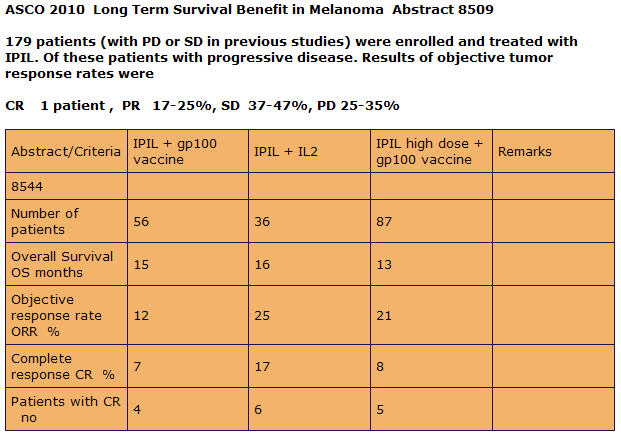
The combination of ipilimumab and IL-2 appears to have an increased complete response rate

Meeting: 2010 ASCO Annual Meeting


Citation: J Clin Oncol 28:7s, 2010 (suppl; abstr 8544)

Abstract No: 8544
Attend this session at the ASCO Annual Meeting!

Session: Melanoma/Skin Cancers

Type: General Poster Session

Time: Sunday June 6, 8:00 AM to 12:00 PM

Location: S Hall A2

Personalize your Annual Meeting experience with a suggested or customized itinerary!


Author(s): P. A. Prieto, J. C. Yang, R. M. Sherry, M. S. Hughes, U. S. Kammula, D. E. White, C. L. Levy, S. A. Rosenberg, G. Q. Phan; Surgery Branch, National Cancer Institute, National Institutes of Health, Bethesda, MD; National Cancer Institute, National Institutes of Health, Bethesda, MD; National Cancer Institute, Bethesda, MD; Surgery Branch, National Cancer Institute, Bethesda, MD


Abstract:

Background: We have previously shown objective clinical responses in patients with metastatic melanoma treated with CTLA-4 blockade using ipilimumab. We have treated 179 patients in 3 separate clinical trials and now have long-term follow-up to evaluate the durability and unique features of this immunotherapy. Methods: A total of 179 patients with metastatic melanoma were treated in 3 trials: In Protocol 1, 56 patients received ipilimumab with gp100 peptide vaccines. In Protocol 2, 36 patients received ipilimumab with high-dose interleukin-2 (IL-2). In Protocol 3, 87 patients received intra-patient dose escalation of ipilimumab and were randomized to receive gp100 peptides. We have updated and analyzed the follow-up and survival data for these trials. Results: With median follow-up for Protocol 1, 2, and 3 being 80, 71, and 60 months, median survival was 15, 16, and 13 months, respectively. Objective tumor regression was 12% for Protocol 1, 25% for Protocol 2, and 21% for Protocol 3. Patients in Protocol 2 had a 17% complete response rate (6 patients: 77+, 74+, 72+, 71+, 71+, and 69+ months), as compared to 7% in Protocol 1 (4 patients: 82+, 81+, 79+, and 66+ months) and 8% in Protocol 3 (5 patients: 64+, 63+, 62+, 60+, and 55+ months); all complete responses are ongoing. Many patients who eventually became complete responders had continual tumor shrinkage after stopping therapy.

Conclusions: CTLA-4 blockade with ipilimumab can achieve durable objective tumor regression in patients with metastatic melanoma. The combination of ipilimumab and IL-2 appears to have an increased complete response rate, although this needs to be tested in a prospective randomized trial. This report represents the largest single-institution experience with the longest follow-up for this agent; our results support its role as a viable treatment option for patients with metastatic melanoma.


Source:http://www.abstract.asco.org/AbstView_74_53615.html


Cytotoxic T lymphocyte-associated antigen 4 blockade with ipilimumab: Long-term follow-up of 179 patients with metastatic melanoma.


It has taken them two years to see the synergy of Ipi + IL-2

My Theory is becoming a reality!!!!!!!!!!!!!!!
Melanoma and the Magic Bullet


The Making of an Immune Response by Combinatorial Therapy Using Anti-CTLA-4 Blockade and Interleukin-2


“It is not the strongest of the species that survives, nor the most intelligent, but the one most responsive to change.”

~Charles Darwin~

Take Care,
Jimmy B
Photobucket

Friday, April 16, 2010

My CT scans have been Approved!! Melanoma ..Jim Breitfeller

My CT scans have been Approved!!
Posted 1 minute ago
My CT scans have been Approved!!!
The scans are scheduled for April 30th. 7:30 am.

I won't be able to release the data because it may Skew the ASCO data that will be released in June at the ASCO Annual Meeting.

God forbid we get the data early so that we, the patients, can make corrections to our path forward.

This is a Joke. ASCO holds back on data results until the start of their meeting and talks.

Why does ASCO embargo Clinical data that is positve before their annual Meeting? Melanoma The patients deserve better. Shame on ASCO!!!

Bristol-Myers Squibb announced the following pipeline highlights:
The company has data from its first phase 3 study (MDX-020) of ipilimumab, which had a primary endpoint of overall survival and was conducted in patients with previously-treated melanoma. Ipilimumab is a novel immuno-oncology compound in late-stage development.

The company has submitted study results for scientific presentation at the American Society of Clinical Oncology (ASCO) annual meeting in June. Management said it is in discussions with health authorities worldwide in planning for submitting biologics licensing applications (BLA) in this patient population.

The company also has data from a randomized phase 2 study of ipilimumab in non-small cell lung cancer that it also has submitted for presentation at ASCO this year. As a result of the study, the company is moving forward with a phase 3 study of ipilimumab in this indication.


Take Care,

Jimmy B
Photobucket

Thursday, May 14, 2009

Ipilimumab linked to melanoma survival: studies..Melanoma..Jim Breitfeller

Thu May 14, 2009 6:01pm EDT

LOS ANGELES, May 14 (Reuters) - More than a third of advanced melanoma patients treated with ipilimumab, an antibody being developed by Bristol-Myers Squibb Co (BMY.N) and Medarex Inc (MEDX.O), continued to survive after 18 months, according to data released on Thursday.
The 18-month survival rate for three Phase 2 trials ranged from 34.5 percent to 39.4 percent. Most trial participants had been previously treated with other therapies.

"The median survival in the past was only six months," said Renzo Canetta, head of oncology research at Bristol-Myers.

Two-year survival results are slated for presentation later this month at a meeting of the American Society of Clinical Oncology in Orlando.

Bristol-Myers and Medarex said last year that they would delay seeking approval of the experimental treatment after U.S. health regulators asked for additional overall survival data to further demonstrate the benefit of ipilimumab.

Canetta said Phase 3 data for ipilimumab in melanoma patients is expected to mature toward the end of this year or early 2010.

Ipilimumab is a fully human antibody that binds to a molecule on T-cells that plays a critical role in regulating natural immune responses to disease. The drug is also being studied in other tumor types, including lung cancer and prostate cancer.

Source:http://www.reuters.com/article/marketsNews/idUSN1434063520090514


Take care

Jimmy B

Thursday, April 30, 2009

All I can say is ASCO needs to review its 1964 Mission Statement, and amend it!! Melanoma..Jim Breitfeller

"The ASCO Annual Meeting is targeted to U.S. and international physicians, academicians, clinical researchers, and other health care professionals involved in multidisciplinary clinical cancer care. Patient advocates that represent national, not-for-profit patient advocacy organizations that provide programs, services, and support for people with cancer, attend as well"


All I can say is ASCO needs to review its 1964 Mission Statement, and amend it.


“As a Non-profit organization, ASCO is dedicated to achieving its charitable mission outline by the organization’s founders in 1964”


You are a company that makes a profit off the healthcare system and have the researchers tied to you like a union. Your membership is like the UAW.


Check out your annual report.

Annual report 2008


Since I don’t fit the mold or what you consider patient advocate, you throw me away like garbage. I am educated and have 4 patents that I coauthored. I spent over 25 years doing research.

Just because it is not in clinical Oncology you cast me aside. I have spent over three years living and breathing and fighting this disease. I know first hand as a patient. I am trying to help

others what is ASCO trying to do? The bottom line is it comes down to money, greed and prestige. What is it for your Organization? Somewhere you lost your charitable mission.

It is the Patient that needs to be educated so they can make an educated decision on the clinical trials. We have to make life threaten decisions. We cannot depend on our local Oncologist to be up on the newest cutting edge technology. We have to be our own advocate and we need access to the latest information.

I guess you can consider me a robin hood of the Melanoma world. The Patients deserve better.


Best regards,


Jim Breitfeller

Tuesday, April 28, 2009

Follow Up on ASCO and Rebuttal.. Melanoma ..Jim Breitfller

"The American Society of Clinical Oncology (ASCO) is a non-profit organization, founded in 1964, with overarching goals of improving cancer care and prevention and ensuring that all patients with cancer receive care of the highest quality. More than 25,000 oncology practitioners belong to ASCO, representing all oncology disciplines."

http://www.linkedin.com/companies/american-society-of-clinical-oncology

At the end of their fiscal year in 2008 they had a net asset value of $22,191,468. This doesn't sound like a non-profit organization.

http://www.ascocancerfoundation.org/ASCO/Downloads/Publications/ASCO%20Annual%20Report%2007-08.pdf

Annual report 2008


Buddy, can you spare a dime so we can get the medical information that we despartly need?

"We also make trusted cancer information available directly to the public. There is no source of cancer information – for physicians or patients – that is more comprehensive, current and trusted than ASCO’s premier website Cancer.Net. All the information and content on Cancer.Net is developed and approved by the cancer doctors at ASCO, making Cancer.Net the most up-to-date and trusted resource for cancer information on the Internet. One of our goals at The ASCO Cancer Foundation is to make this information widely available and expand cancer literacy. We understand the power of knowledge. Our work extends that power to cancer doctors and patients around the world."

Then why are they charging for vitual meeting?

I guess the bottom line is $$$$$$$$$$.

Jimmy B

ASCO Denies Patient Advocate Scholarship!!! Melanoma.. Jim Breitfeller

"The 2009 ASCO Annual Meeting will be a forum for cutting-edge scientific and educational developments in oncology with a focus on personalizing cancer care."

This Year the Meeting will be held in Orlando, Florida.


From: patientadvocates [mailto:patientadvocates@asco.org] Sent: Monday, April 27, 2009 2:46 PM To:
dbreitfe@rochester.rr.comCc: patientadvocatesSubject: ASCO Annual Meeting

Dear Mr. Breitfeller,
Thank you for applying for a patient advocate scholarship to attend the 2009 ASCO Annual Meeting in Orlando, May 28 – June 2.

We regret to inform you that we will not be able to provide you with a scholarship for this year’s ASCO Annual Meeting.

If you are still interested in the Meeting, you are welcome to subscribe to the Virtual Meeting at a discounted rate of $70 (the normal rate for non-ASCO members is $275).

With a Virtual Meeting subscription, subscribers will be able to view audio and slides of presentations made at the Meeting. Virtual Meeting includes exclusive access to the 2009 Annual Meeting content for 180 days following the meeting. All sessions will be available to the public beginning December 1, 2009. All non-ticketed sessions are included (Education, Clinical Science Symposia, Oral Abstracts, Posters). Presentations will be loaded to the Virtual Meeting section of ASCO.org (www.asco.org/vm) as they are made available. The majority of presentations will be available within 24 hours of the session’s completion. Please let us know if you would like to purchase the Virtual Meeting and we will facilitate that process for you.

If you have any questions, please feel free to contact us at any time.

Best Regards,

Jeannine Salamone &
DeShanna McGee

American Society of Clinical Oncology
Communications & Patient Information Department
2318 Mill Road, Suite 800
Alexandria, VA 22314

patientadvocates@asco.org

If you think I should go, please send a letter to ASCO.

patientadvocates@asco.org

So I asked who won the scholarship?

response: Mr. Breitfeller,

I cannot release the names of the scholarship recipients. I am sorry we were not able to give scholarships to all who applied. We had very limited funds to work with, most likely due to the state of the economy.

Best,


Jeannine


Jimmy B

Saturday, April 25, 2009

Melanoma Update: Highlights of research presented at ASCO and an update on vaccines trials.Melanoma..Jim Breitfeller

Issue Number:
Volume 17 - Issue 3 - March 2009
author:
John Otrompke, Contributing Editor
Mixed Melanoma Trial Results Point to Need for Tailored Studies

"Effective melanoma therapies may be inching forward, with a number of the new class of potential therapeutics in the pipeline entering Phase III trials, and researchers presenting some of the first published data on other agents at this year’s annual meeting of the American Society of Clinical Oncology (ASCO) in Chicago.

But with mixed results, some disappointing, some surprising, some researchers say clinicians and clinical trial designers must rethink development strategies, including patient selection, if some of the new class of biological therapeutics for melanoma are to make significant headway.

“The problem with melanoma is that, other than surgery, there really are no very good effective therapies. The chemotherapies that are out there are not curative but palliative treatments,” explains David Solit, MD, Elizabeth and Felix Rohatyn Chair and Assistant Attending Physician, Department of Medicine, Sloan-Kettering Cancer Center.

But medical science is progressing, says Dr. Solit, who spoke at the ASCO conference. “We actually know a lot of the genetic alterations that cause the cancer. In 2002 there was a mutation in a protein called BRAF that was identified, and the mutation is found in the tumor in 50% to 70% of patients with melanoma. Then there’s a protein called NRAS, which also gets mutated in 15% to 20% of melanoma patients. But when you have an NRAS mutation, you don’t have a BRAF mutation. In total, between 60% and 90% of patients have one of the two,” says Dr. Solit, who gave the presentation, “Genetic Predictors of RAF/MEK Dependence.”

But the news at ASCO was not all good for the new therapies.

Early Promise, Mixed Results

Some of the most important new strategies for treating advanced melanoma focus on the patient’s immune system.

“Two of the strategies use anti-CTLA 4 and anti-PD1 agents to take the brakes off the patient’s immune system. Both are receptors on a patient’s T-cells, which are part of the normal braking system, which is a good thing at most times, but not a good thing in regards to a cancer cell,” says Walter Urba, MD, PhD, Director of Cancer Research at the Earle A. Chiles Research Institute in Portland, Oregon.

“The other two strategies use antibodies 41BB or OX 40. At ASCO this year, we saw some late clinical trial results with the anti-CTLA 4 product, and the first published results with anti-41BB and anti-PD1,” says Dr. Urba, who also discussed very early results with his own institution’s investigational agent, OX 40.

A disappointing trial of a new potential therapeutic agent was a head-to-head trial of an agent called a MEK inhibitor, which was tested against temozolomide, a standard pre-existing chemotherapy for melanoma. There was no significant difference between the standard arm and the MEK inhibitor (AZD 6244 by Astra Zenaca), according to the trial results.

However, patient selection may be the problem. “Genetic differences are relevant, because the BRAF mutation found so often in melanoma patients, activates a protein called MEK. “If you have a RAF mutation, you may respond a lot better to a MEK inhibitor,” explains Dr. Solit, noting that in addition to the Astra Zenaca drug, another MEK inhibitor in research is a drug from Pfizer called PD 0325901. The Astra Zenaca drug, which encountered the disappointing result, is in Phase II trials, whereas the MEK inhibitor from Pfizer is only in Phase I.

“The problem with the Astra Zenaca trial is that they didn’t look for BRAF-mutated patients. It’s possible temozolomide is as good or better than AZD 6244 in unselected patients, but five of the six responders in the MEK inhibitor arm had BRAF mutations,” Dr. Solit says. “There is technology out there already to start looking for these mutations, and it has already become routine in lung cancer for other genes.”

There were some positive, surprising results presented as well, however. A Phase II trial of ipilimumab, an investigational immunomodulatory agent from Bristol Meyers Squibb, which is in late Phase III trials, was studied in a population of 115 patients in combination therapy with Budesonide, a currently existing therapy. “Our primary endpoint was to see whether in a randomized trial we could reduce the amount of diarrhea that occurs as a side effect of the Budesonide, and our primary endpoint was not successful, but ironically, the clinical results were outstanding. Our median survivals were over a year,” says Jeffrey Weber, MD, PhD, Director of the Donald A Adam Comprehensive Melanoma Research Center and Professor of Oncologic Sciences at the University of South Florida.

Updated survival data of three Phase 2 studies of ipilimumab in patients with metastatic melanoma (Stage III or IV) who had previously been treated were presented at the European Society for Medical Oncology in Stockholm. Study results show that approximately half of patients who received ipilimumab (10 mg/kg) remained alive beyond 1 year. The results are based on follow-up of the patient population from studies 008, 022 and 007 treated with 10 mg/kg of ipilimumab (induction and maintenance) and show a consistent 1-year survival rate between 47% and 51%.

Combination Therapies of the Future, Today

Another promising strategy offering hope to advanced melanoma patients is to stimulate the patient’s immune system, by mimicking signal’s sent naturally by the body.

“We have learned from studying patients with melanoma just how powerful the immune system can be, but we need to supplement the response, and free it from some of its limitations,” says Robert H. Vonderheide, MD, Assistant Professor of Medicine at Abramson Cancer Center at the University of Pennsylvania.

The immune response in melanoma patients can be so pronounced that in rare cases, tumors even shrink in the face of it, says Dr. Vonderheide.

Dr. Urba agreed. “The immune response in melanoma is different from other cancers,” he explains. “One of the thoughts is that melanoma tumors are more immunogenic. Sometimes the response occurs after disease progression. In a couple percent of every patient population, the patient comes in and looks for all the world like they’re having tumor progression, and they end up having the tumor go away in response. The rationale is, that maybe it takes time for an immune response to build up and eliminate tumor cells following these investigational therapies,” he says, noting that these delayed responses can occur 8 or 12 weeks following therapy.

To attempt to take advantage of melanoma’s unique immunogenicity, Pfizer has developed an investigational agent that acts on an immune receptor called CD40, according to Dr. Vonderheide. “This is an antibody that binds to CD40 and mimics the signal sent to activate the immune system.”

The CD40 agonist has been tested by itself and in conjunction with standard chemotherapy drugs carboplatin and paclitaxel. The first clinical trial with the agent started about 4 years ago, and was reported 2 years ago at ASCO. Though the drug is only in Phase I trials, “taking it to Phase II is definitely warranted,” notes Dr. Vonderheide. “In the second study, we saw clinical activity: one patient has regressed, and remained in remission for years.”

In another study, the CD40 agonist will be given, along with chemotherapy, every 3 weeks, and the trial is enrolling as many as 30 patients, according to Dr. Vonderheide.

With some of the therapies, lack of experience in testing them may lead to unpredictable future results; in others, the sheer longevity of their period in trials can lead to skepticism.

“Anti-CTLA 4, an anti-inhibitory drug, has probably been in clinical trials for about 7 years, whereas anti-PD1, which is also an anti-inhibitory drug, has probably not been in trials for much more than a year,” says Dr. Urba, noting that the 41BB has also been in trials for 2 years.

For some drugs, clinical trials have enrolled hundreds of patients over the years, while other novel agents have only been tested in a few dozen humans. “The delayed response phenomenon, for example, has not been seen with other agents besides ipilimumab and tremilimumab, but with the other agents, the number of patients who have been treated is so small I’m not sure if we would have seen it,” he adds.

Still, the novel agents, whether young or old, often offer the only hope for advanced melanoma patients to hold onto.

“Nonetheless, it’s probably going to be a long series of trials to figure out which are the patients who are going to benefit. It’s a targeted therapy, and it doesn’t work for everybody. But we have insight into who it would work in, and we need to incorporate that information into our clinical trial design,” Dr. Solit says."


source: http://www.skinandaging.com/content/melanoma-update-highlights-research-presented-asco-and-update-vaccines-trials

Melanoma Update: Highlights of research presented at ASCO and an update on vaccines trials


Take care
Jimmy B

Thursday, April 9, 2009

A letter to my Congressman. Melanoma .. Jim Breitfeller

I hope to make contact with my Congressman tonight.

Here is a copy of that letter:

Congressman Dan Maffei,

I have a story to tell.

Last July (2005) I was riding my bicycle to work at the Eastman Kodak Research Labs about 3 miles from home; I was wearing a knapsack to carry my things to and from the labs. I started noticing an ache on my back. So I decide to go to the dermatologist. To make the log story short, it was cancer. Melanoma.

Over 64000 a year are diagnosed with Melanoma and 8500 will die this year alone. There is no cure for this type of cancer and if you progress to a stage IV were it has metastized, you usually have 6 to 9 months to live.

Anyway, I had to go out of state to get the specialized treatment. In doing so, I did four clinical trials to try to save my life. The last two were immunology therapy. One was anti-CTLA-4 blockage (Monoclonal antibodies) and the other was high dose Interluekin-2 (IL-2). These combinations of therapy just so happen to jump start my immune system. At the time of the therapies I had 40+ tumors in my Lungs.
Today 26 months, I am (NED) no evidence of disease.

So being a researcher by profession at Eastman Kodak for 25 years (I hold a couple of patents that I helped coauthored), I began to research and piece together why my treatment has worked. I have contacted Dr. Steven a Rosenberg and other colleagues to review my Theory.

Here are just some of the responses from the Clinical Oncologists:

“Fine theory but just theory that has never been tested in relevant clinical setting…”

“May I forward this to one of my colleagues? He may have some insights.”

“Thanks for your note. You really refreshed my mind! I am glad things have worked out relatively well for you!. Did you get rid of your disease? I am glad you are writing your story and hopefully inspiring a number of patients in dire need of hope. Let me know how can I help.”

“Thank you so much for sharing your experience and thoughts.
Some patients have indeed experienced tantalizing responses after treatment with CTLA4 antibodies. Let me assure you that many of us in the field keep working hard on figuring out what explains those successes so that, armed with that knowledge, we can extend the benefit to many cancer patients. Experts agree that the way forward requires combinations of immunotherapies. Despite the many obstacles (scientific, regulatory, operational, intellectual property, economic, etc), Pfizer Oncology is moving decisively in that direction.”


“Congratulations,
I think you may find our ASCO abstracts interesting this year. Especially the one that talks about the time dependent variability of immunoreactivity in patients with melanoma.”

(ASCO) is the American Society of Clinical Oncology. The meeting this will be held on May 31-June 2, 2009 in Florida.

As you can see, I am trying to get the word out and hopefully gain some traction. I have tried to contact the two drug companies because this treatment/ theory involves their two drugs and they must be used in concert together to obtain a synergic immune response.

Dr. Rosenberg and colleagues did a trial at the NCI but the dosage and the timing of each of the drugs were not done at optimal conditions at the time. Based on my theory and other researchers now know that there is a “time dependent variability of immunoreactivity in patients with melanoma” and that a higher dose is needed to obtain a immune response.

“I don’t think we can draw any conclusions yet based on your experience with a single dose. However, one thing we do know is that dose does matter. Last year at ASCO, we presented data showing that higher doses of ipilimumab (10 mg/kg) were better than 3 mg/kg or 0.3 mg/kg. I once again applaud you for your efforts to understand the excellent response which you have had.”

As you can see, I am passionate in finding a cure/stabilization. I have come to you as my representative, to ask for your assistance to help further this cause because I believe this will benefit the Nation as a whole and even the world as it pertains to today. We need to get this Drug FDA approved as soon as possible.

We can stand up to cancer and Move Mountains if we all work together!!!!!!!!!!


Thank you for your time and I hope to hear from you soon.

Please don’t let this fall on deaf ears. I will volunteer to help move this forward. We owe it to the 65000+ patients in Our Country and the world.


Sincerely,


James M. Breitfeller ( Patient/Survivor/Researcher of Melanoma Stage IV)

Friday, March 27, 2009

YESssssssssssssss!!! Confirmation of my Theory Melanoma.. Jim Breitfeller

Congratulations,

I think you may find our ASCO abstracts interesting this year. Especially the one that talks about the time dependent variability of immunoreactivity in patients with melanoma.

Take care,
Svetomir

The American Society of Clinical Oncology (ASCO) is the world's leading professional organization representing physicians who treat people with cancer.

Svetomir N. Markovic, M.D

Education:

Fellowship – Department of Internal Medicine; Division of Hematology, Department of Oncology
Mayo Graduate School of Medicine

Residency – Internal Medicine
Mayo Graduate School of Medicine

Medical College of Pennsylvania

Fellowship – Part-time Post-doctoral; Microbiology/Immunology, Pharmacology
Medical College of Pennsylvania

Ph.D. – Department of Microbiology/Immunology
Medical College of Pennsylvania

Areas of Research
Melanoma

Cancer Immunology and Immunotherapy Program
Clinical Immunology and Immunotherapeutics
Department of Immunology
Prostate Cancer Program
Translational Immunovirology and Biodefense Program
Academic Affiliations
Clinical & Translational Science Program
Immunology Program


Summary:

Translational immunotherapeutics of cancer focused on malignant melanoma and non-Hodgkin's lymphoma. This work includes development and clinical testing of: cancer vaccines; immune boosting agents; novel agents that reconstitute immunity in patients with cancer; and combination therapy directed at enhancing anti-tumor immune responses.


Yes Now I can say my theory holds water and just coming out in May/June at the ASCO
Meeting.I am trying to get this out to all the clinical Oncologists. So they can incorporate this into there trials. I hope I am not stepping on any Toes.

Photobucket

Jimmy B

Sunday, March 8, 2009

Tremelimumab dose selected for further testing due to favorable Safety, Tumor Response in Melanoma ..JimBreitfeller

Posted February 25, 2009
Tremelimumab given at two dosing regimens afforded durable tumor responses in patients with metastatic melanoma, according to data from a phase-1/2 trial.

Researchers conducted a phase-1/2 trial to assess the safety of tremelimumab in multiple doses and to examine the efficacy of the agent and the appropriate dosing regimen.

To determine the recommended phase-2 dose, phase-1 IV infusions of tremelimumab at 3 mg/kg, 6 mg/kg or 10 mg/kg were given to 28 patients with metastatic melanoma for up to one year. During phase 2, 89 patients received tremelimumab 10 mg/kg once each month or 15 mg/kg every three months.

The researchers reported no dose-limiting toxicity during phase 1. Eighty-four patients were assessable for response during phase 2 at which time 10% reached objective antitumor responses; one complete response and three partial responses in each dosing regimen comprised the best overall objective response.

Most responses ranged from three to 30 or more months and the most common adverse events were diarrhea, rash and pruritus. Grade-3/4 adverse events had a frequency of 13% in the 15 mg/kg arm and 27% in the 10 mg/kg arm. Frequency of serious adverse events was 9% in the 15 mg/kg arm vs. 23% in the 10 mg/kg arm.

“Both phase-2 regimens generated durable tumor responses,” the researchers wrote. “Based on its more favorable safety profile, 15 mg/kg every three months was selected for further clinical testing.” – by Stacey L. Adams

J Clin Oncol. 2009;doi:10.1200/JCO.2008.19.2435

The phase-3 data from ASCO, in terms of survival, show that tremelimumab given at 15 mg/kg every three months is a bit better than for the control arm of dacarbazine (DTIC-Dome, Bayer Healthcare) or temozolomide (Temodar, Schering). But, the difference was not statistically significant; median survival was a month better, but this is less than we were looking for. So we must ask: What is the real difference between clinical responses to tremelimumab and dacarbazine? In the recently published study of Camacho et al reporting the phase-1/2 experience and the larger phase-2 multicenter study I presented to ESMO and ASCO in 2008, as well as in the phase-3 experience that Toni Ribas presented to ASCO, there are very profound differences between the type of responses seen with anti-CTLA4-blocking antibodies and with conventional chemotherapy. About 8% to 10% of patients with melanoma have objective response to this modality and the majority of these have a very durable response. For example, in the phase-2 trial results I reported to ASCO and ESMO, 15 of 16 patients who had objective response with tremelimumab response was durable past six months -a very different pattern than we see for dacarbazine and temozolomide. Tremelimumab and ipilimumab are active agents in a fraction that is roughly the same as interleukin-2, interferon-alfa, and dacarbazine or temozolomide. In the largest trial of temozolomide ever conducted - results recently presented at ESMO by Patel et al.- response rates were 10% for dacarbazine vs. 14.8% for temozolomide, but there was no difference in the overall survival or the progression-free interval between these regimens. Dacarbazine and temozolomide responses do not seem to confer survival benefit in part because these responses are rarely durable. The 10% of patients who responded to the anti-CTLA4-blocking antibodies exhibit characteristically and qualitatively different kinds of responses in metastatic stage-4 disease.

When looking at the difference between the phase-3 and phase-1/2 trials, the phase-1/2 results clearly show that for tremelimumab there are very durable, high-quality responses--and the same can be said for ipilimumab. But the problem is, when you conduct a conventional trial in advanced metastatic melanoma to look at median survival, the survival median provides a different readout than the readout of durable responses. The quality of responses to tremelimumab and ipilimumab are still worthy of pursuit. The fact that the phase-3 trial of tremelimumab shows a little better outcome than dacarbazine in terms of median survival does not reflect these high-quality responses that go out well past six months, and will take different follow-up to document. So that is what is going on now: the long-term follow-up of those patients to make a qualitative assessment of the kind of response that they exhibited is really what we need.

Looking at the data from the phase-3 presentation by Ribas, the one thing that may have weighed differentially in favor of tremelimumab in the forest plot of the data was higher lactate dehydrogenase (LDH). This is curious when you think about it. It may or may not be real, but if patients who have higher LDH (perhaps worse disease) benefit more from tremelimumab than from dacarbazine or temozolomide, the study was designed in a way that may have disfavored the anti-CTLA4-blocking antibody. The protocol excluded those people who had higher than twofold elevated LDH – so, by the design of the trial, curiously the outcome may have been slanted in favor of temozolomide or dacarbazine.

Finally, it remains to test the role of anti-CTLA4 blocking antibodies in the disease setting where we have found the greatest relative benefit for other immunotherapy, such as IFN alpha. The adjuvant exploration of anti-CTLA4 blocking antibodies may show even greater relative benefit and warrants phase-3 study in relationto IFN alpha.

– John Kirkwood, MD

Source:http://www.hemonctoday.com/article.aspx?rid=36459

Tremelimumab dose selected for further testing due to favorable safety, tumor response in melanoma


Jimmy B

Monday, March 2, 2009

Update on Federal and State Clinical Trials Legislation Melanoma .. Jim Breitfeller

ASCO continues its advocacy efforts at the federal and state levels to provide insurance coverage for the routine costs associated with patient participation in cancer clinical trials.

In Congress, Rep. Steve Israel (D-NY) has introduced the Access to Cancer Clinical Trials Act (HR 716)
. The legislation would require all health insurers – including those regulated by state insurance laws – to provide coverage for cancer clinical trials. Sen. Sherrod Brown (D-OH) introduced a companion bill in the Senate last year and is reportedly planning to do the same in this session of Congress.

Below is an update on five states that are considering legislation to require insurance companies to cover the routine patient care costs associated with clinical trials:

Colorado: On February 10, ASCO joined Rocky Mountain Oncology in sending a letter to Rep. Dianne Primavera in support of her bill (HB 09-1059) to require insurance companies to provide coverage to patients enrolled in all types of clinical trials. The legislation has passed a House Committee.

Nebraska: On February 13, ASCO and the Nebraska Oncology Society (NOS) sent a letter to State Sen. Mike Gloor, who is sponsoring legislation (LB 378) that would require insurance companies to provide coverage to patients enrolled in all types of clinical trials. ASCO and NOS also sent letters to members of the Senate Banking, Commerce, and Insurance Committee in support of the legislation, as the Committee held a hearing on February 17 on the legislation. ASCO also submitted written testimony in support of the bill.

Alaska: On February 18, ASCO President-Elect Douglas W. Blayney, MD, testified and ASCO submitted written testimony to a state Senate Health, Education and Social Services Committee hearing in support of legislation (SB 10) that would require insurers to provide coverage to patients participating in cancer clinical trials. ASCO is working with the Denali Oncology Group, ASCO’s affiliate society in Alaska, to support the legislation.

Iowa: ASCO also supports Iowa legislation (HSB 85 and SF 21) that would require insurers to provide coverage to patients enrolled in cancer clinical trials, and plans to work with the Iowa Oncology Society to support the legislation.

Kentucky: The House is considering legislation (HB 30) to require clinical trials coverage, and a companion bill has been introduced in the Senate (SB 102).

If these bills pass, these five states would join the 22 states and the District of Columbia that already have laws requiring clinical trials coverage. An additional three states have negotiated cooperative agreements with insurers to cover clinical trials. Information about these states is available on the NCI Web site
.

This is not a complete list of all the states that are considering clinical trials coverage legislation. If you are aware of clinical trials legislation under consideration in your state that is not listed here, contact ASCO’s Cancer Policy & Clinical Affairs Department at 571-483-1670 or researchpolicy@asco.org. ASCO can provide resources to help you in your advocacy efforts for state legislation.

Update on Federal and State Clinical Trials Legislation


Source:ASCO

Take care

Jimmy B

Tuesday, February 3, 2009

You heard it here first..“Personalized medicine is the next frontier in cancer care,”Melanoma ..Jim Breitfeller

This is not about Melanoma it is about the "New Frontier in Medicine"

I can See this happening with Melanoma down the road.

American Society of Clinical Oncology (ASCO)
ASCO Releases its First Provisional Clinical Opinion (PCO)


Patients with metastatic colorectal cancer who are candidates for anti-EFGR therapy should have their tumors tested for KRAS gene mutations, according to ASCO’s first Provisional Clinical Opinion (PCO).

If a patient has a mutated form of the KRAS gene, the Society recommends against the use of anti-EFGR antibody therapy, based on recent studies indicating this treatment is only effective in patients with the normal (wild-type) form of the KRAS gene. It is estimated that 40% of patients with colon cancer have the KRAS mutation.

“Personalized medicine is the next frontier in cancer care,” said Richard L. Schilsky, MD, ASCO President. “Using KRAS testing to guide colorectal cancer treatment is a prime example of where cancer care is heading.”

“Basing cancer treatment on the unique genetic characteristics of the tumor or the individual with cancer will improve patient outcomes and help avoid unnecessary costs and side effects for patients who are unlikely to benefit,” Dr. Schilsky added.

PCOs are intended to offer timely preliminary clinical direction to oncologists following the publication or presentation of potentially practice-changing data from major studies. ASCO’s PCO on KRAS gene testing was given prior to the January 15-17, 2009 Gastrointestinal Cancers Symposium in San Francisco, California. The Symposium was co-sponsored by ASCO, the American Gastroenterological Association (AGA), the American Society for Radiation Oncology (ASTRO), and the Society of Surgical Oncology (SSO).

Among the 500 presentations was an important economic and scientific study that discussed the possibility of more than half a billion dollars in savings for the United States healthcare system. The study showed that routine testing for KRAS gene mutations in patients with metastatic colorectal cancer could save the U.S. health system up to $604 million per year by identifying who would benefit from the drug cetuximab.

Information on the PCO is currently available on ASCO.org, and the entire report will be published in the next issue of the Journal of Clinical Oncology (JCO).

Jimmy B

Greetings to One and All

This Blog is dedicated My Brother Kenny B. who passed away in the late 1970's with Cancer before the Internet.

It was he, who showed me How to live and give back. He was wise beyond his years.


Kenny B


Jimmy and Dee

Carepage: Jimmybreitfeller
Jimmy Breitfeller


My Profile as of 2009

My photo
Last July (2005)I was riding my bicycle to work at the Eastman Kodak Research Labs about 3 miles from home. I was wearing a knapsack to carry my things to and from the labs. I started noticing an ache on my back. So I decide to go to the dermatologist. To make the long story short, it was cancer. I knew from my research that I would be needing adjuvant therapy. So I started communicating with Sloan Kettering, University of Pittsburgh Cancer Center, and a couple of others including the Wilmot Cancer Center at Strong. I realized that by telling my story, I might help someone else out there in a similar situation. So to all who are linked by diagnosis or by relation to someone with melanoma, I wish you well. Stay positive, read as much as you can (information helps to eliminate the fear associated with the unknown), and live for today, as no one can predict what tomorrow may bring. Jimmy B. posted 12/15/08

Disclaimer

The information contained within this Blog is not meant to replace the examination or advice of your Oncologist or Medical Team. The educational material that is covered here or Linked to, does not cover every detail of each disorder discussed.

Only your physician/Oncologist can make medical decisions and treatment plans that are appropriate for you. But, An Educated Consumer is a Smart consumer.

As Dr. Casey Culberson Said:

"The BEST melanoma patient is an ACTIVE PARTICIPANT in his or her treatment
(not a PASSIVE RECIPIENT)"

Melanoma and the “Magic Bullet” (Monoclonal Antibodies)

Just to let you know I posted the first draft of the Melanoma and the “Magic Bullet” (Monoclonal Antibodies). on Melanoma Missionary In the Shared File Section. you can download it for 19.95 (Only kidding) it is Free for the taking.


It is 33 pages long and may help you in your quest for the Yellow Brick Broad. Just to let you know it is only the first draft. Revisions are sure to come. I wanted to get it to the people that need it the most, the Melanoma Patients.

Preview:

So, where does Interluekin-2 (IL-2) come into play? According to Byung-Scok et al and recent reports, IL-2 is not needed for developmental CD4+ CD25+ Treg cells in the thymus but does play an important role in the maintenance and function in the peripheral.18 Peripheral is defines as secondary system outside the bone marrow and thymus. It entails the site of antigen, immune system interaction. IL-2 is required for the peripheral generation of Tregs based Abbas’s and colleagues research.19

IL-2 prevents the spontaneous apoptosis of the CD4+ CD25+ Treg cells. It has been reported that patients with multiple advance-stage tumors have elevated levels of Tregs within the tumor microenviroment.20 Interluekin-2 is the survival factor for CD4+ CD25+ Treg cells.21 If the addition of IL-2 is on or before the maximum propagation of the CD4+ T cells, the Tregs population can increase 5-fold in a 96 hour period based on certain growth mediums.

By controlling the addition of the endogenous IL-2, one has a knob to turn and can lead to the control of the expansion of the Tregs. When you combined this control with the anti-CTLA-4 blockage, you can shift the balance of the immune response.

Now here is the catch. The maintenance and function of the CD8+ T-cells require CD4+ cells which secrete IL-2. So we don’t want to deplete the CD4+ cells, we want to control the expansion of the Tregs which are a subset of the CD4+ cells. It has been postulated by some researchers that the Anti-CTLA-4 blockage also suppresses the Treg function in a different mechanism. By using IL-2 as the rate limiting factor, we can suppress the CD4+ CD25+ Treg cell expansion by controlling the concentration and timing of the Inerluekin-2 at the tumor microenvironment.


The Interluekin-2 plays another role in this Melanoma Maze. In a study by Janas et al, Il-2 increases the expressions of the perforin and granzyme A, B and C genes in the CD8+ T-cells. This increase expression causes the CD8+ T-cells to mature into Cytoxic T Lymphocytes (CTLs). The exogenous IL-2 is required for the granzyme proteins. As stated previously, CTLs have cytoplasmic granules that contain the proteins perforin and granzymes. A dozen or more perforin molecules insert themselves into the plasma membrane of target cells forming a pore that enables granzymes to enter the cell. Once in the tumor cell, these enzymes are able to breakup (lyse) the cell and destroy it. This is the beginning of the end for the cancer cells. The tumors begin to shrink and the rest is history,


On the other hand, prolong therapy with Il-2 can result in causing apoptotic death of the tumor- specific CD8+ T-cells.23

Clearly in a clinical setting, timing, dose, and exposure to these drugs play a major roll in the immunotherapy, and can have dramatic effects on the outcome.

All it takes is that one magic bullet to start the immune reaction..

https://app.box.com/shared/kjgr6dkztj

Melanoma And The Magic Bullet (Monoclonal Antibodies)

Public Service Announcement

A call for Melanoma Patients by Dr. Steven A Rosenberg

"We continue to see a high rate of clinical responses in our cell transfer immunotherapy treatments for patients with metastatic melanoma", Dr. Rosenberg said.

"We are actively seeking patients for these trials and any note of that on a patient-directed web site would be appreciated."

If you would like to apply for his trials, here is the website and information.

Dr. Rosenberg's information


Dr. Rosenberg's Clinical Trials


For the Warriors


The Melanoma Research Alliance has partnered with Bruce Springsteen, the E Street Band, and the Federici family to alleviate suffering and death from melanoma. Please view Bruce Springsteen’s public service announcement inspired by Danny Federici. Danny was the E Street Band’s organist and keyboard player. He died on April 17, 2008 at Memorial Sloan-Kettering Cancer Center in New York City after a three year battle with melanoma.


http://www.melanomaresearchalliance.org/news/PSA/

Source Fastcures blog


Join the Relay for Life!!!

Photobucket

Dear Family and Friends,

I’ve decided to take a stand and fight back against cancer by participating in the American Cancer Society Relay For Life® event right here in my community! Please support me in this important cause by making a secure, tax-deductible donation online using the link below.

To donate on line now, click here to visit my personal page.
Jimmy B AKA Melanoma_Missionary

Relay For Life® is a life-changing event that brings together more than 3.5 million people worldwide to:

CELEBRATE the lives of those who have battled cancer. The strength of survivors inspires others to continue to fight.

REMEMBER loved ones lost to the disease. At Relay, people who have walked alongside people battling cancer can grieve and find healing.

FIGHT BACK. We Relay because we have been touched by cancer and desperately want to put an end to the disease.

Whatever you can give will help - it all adds up! I greatly appreciate your support and will keep you posted on my progress.

Keep the Fire Burning!!!

Photobucket

Sincerely,

Jimmy Breitfeller
Turn off Music before you "Click to Play"
Signs of Melanoma Carcinoma Skin Cancer

How Skin Cancer Develops by "About.com : Dermatology"

Call for Patients with Unresectable Liver Metastases Due to Melanoma


Delcath Systems Granted Orphan-Drug Designations for Cutaneous and Ocular Melanoma


Delcath is actively enrolling patients in a Phase III clinical trial testing its proprietary drug delivery system, known as Percutaneous Hepatic Perfusion (“PHP”), with melphalan for the treatment of ocular and cutaneous melanoma metastatic to the liver.

This NCI-led trial is enrolling patients at leading cancer centers throughout the United States. Commenting on these orphan-drug designations, Richard L. Taney, President and CEO of Delcath, stated, “These favorable designations are important steps in our efforts to secure Delcath’s commercial position upon conclusion of our pivotal Phase III trial for metastatic melanoma. We remain steadfast in our commitment to become the leader in the regional treatment of liver cancers and we continue to enroll patients in this study, and advance our technology and the promise that it offers to patients with these deadly forms of melanoma and other cancers of the liver, all with limited treatment options.”

Orphan drug designation, when granted by the FDA’s Office of Orphan Products Development, allows for up to seven years of market exclusivity upon FDA approval, as well as clinical study incentives, study design assistance, waivers of certain FDA user fees, and potential tax credits.


Current Trial Centers


Phase I Study of Hepatic Arterial Melphalan Infusion and Hepatic Venous Hemofiltration Using
Percutaneously Placed Catheters in Patients With Unresectable Hepatic Malignancies


James F. Pingpank, Jr., MD, FACS
Associate Professor of Surgery
Division of Surgical Oncology
Suite 406, UPMC Cancer Pavillion
5150 Centre Avenue
Pittsburgh, PA 15232
412-692-2852 (Office)
412-692-2520 (Fax)
PingpankJF@UPMC.edu


Blog Archive

Call For Melanoma Patients!!!!

Call For Melanoma Patients!!!!

Dr. Rosenberg Has a New Clinical Trial.

Our latest treatment has a 72% objective response rate with 36% complete responses.

We are currently recruiting patients for our latest trial.

Is there some way to post this “Call for Patients” on the web site?

Steve Rosenberg

Dr. Rosenberg's Clinical Trials


(For a copy of the research paper.. see My Shared files)

The news headlines shown above for Melanoma / Skin Cancer are provided courtesy of Medical News Today.