Showing posts with label Depletion of Treg cells. Show all posts

Saturday, July 31, 2010

In Stage IV melanoma patients, a high percentage of Tregs appears to be associated with shorter survival. Jim Breitfeller

In Stage IV melanoma patients, a high percentage of Tregs appears to be associated with shorter survival.

Received 12 February 2008 published online 03 June 2008.

Background

Melanoma often elicits a profound immune response, and this response has been exploited by various immune therapies. These immunotherapies ultimately fail, however, and advanced melanoma is uniformly fatal, suggesting the development of an immune escape mechanism. In this study, markers of immune escape including regulatory T cells (Tregs), dendritic cells (DCs), and TGF-β were evaluated in 14 Stage IV melanoma patients and correlated with survival.

Source:http://www.journalofsurgicalresearch.com/article/S0022-4804(08)00344-2/abstract

In Stage IV melanoma patients, a high percentage of Tregs appears to be associated with shorter survival


Just follow the Science!!!!!!


Results

Stage IV melanoma patients had a doubling of regulatory T cells compared to both normal subjects and stage I melanoma patients. There was a significantly higher number of DCs in all melanoma patients compared to normal subjects. Stage I melanoma patients had a significantly higher number of pDCs than normal subjects, and all melanoma patients had a higher concentration of mDCs than controls. Serum IL-4 and IL-10 were not detectable but serum TGF-β levels were significantly higher in stage I and stage IV melanoma patients compared to normal controls.

Conclusion

Advanced melanoma is associated with increased numbers of circulating dendritic cells and regulatory T cells. These data suggest that melanoma induces immunosuppressive DCs and regulatory T cells in the systemic circulation.


Source:http://www.springerlink.com/content/k0gk8740u3n75744/


“It is not the strongest of the species that survives, nor the most intelligent, but the one most responsive to change.”
~Charles Darwin~

Take Care,
Jimmy B

Photobucket

Tregs and rethinking cancer immunotherapy..Melanoma..Jim Breitfeller

Tregs and rethinking cancer immunotherapy

Tyler J. Curiel

San Antonio Cancer Institute, University of Texas Health Sciences Center, and Cancer Therapy & Research Center, San Antonio, Texas, USA.
Address correspondence to: Tyler J. Curiel, San Antonio Cancer Institute, University of Texas Health Sciences Center, 7703 Floyd Curl Drive, San Antonio, Texas 78229-3900, USA. Phone: (210) 562-5286; Fax: (210) 562-5292; E-mail: curielt@uthscsa.edu.


Abstract
Introduction

Tumors express antigens that should induce immune-mediated rejection, but spontaneous rejection of established tumors is rare. Recent work demonstrates that one reason for the lack of tumor rejection is that tumors actively defeat host immunity. This concept forces us to rethink current approaches to harnessing potent, specific host immunity to battle cancer, most of which are based on the paradigm that inducing more antitumor immune cells alone is therapeutic. However, as I discuss in this Personal Perspective, a newer paradigm predicts that reducing tumor-driven immune suppression will be clinically beneficial. CD4+CD25+ Tregs are one mechanism of tumor-driven immune evasion that provide prototypical targets for testing novel anticancer treatment strategies within the newer paradigm.

Source:http://www.ncbi.nlm.nih.gov/pmc/articles/PMC1857250/

Tregs and rethinking cancer immunotherapyA>


This paper is one of the better ones for understanding the whole Treg Thing. Ipilimumab and Interluekin-2 in combination will change the paradigm in novel anticancer treatment strategies as we see it today and may hold the key to durable remissions of melanoma.


“It is not the strongest of the species that survives, nor the most intelligent, but the one most responsive to change.”

~Charles Darwin~


Take Care,
Jimmy B

Photobucket

Monday, July 26, 2010

Tamed T-Cells leave patients cancer-free..Melanoma..Jim Breitfeller

The science is coming in loud and clear. Remember I said blame it on the Tregs!!!!! Well Here is some conformation of that.

Tamed T-Cells leave patients cancer-free
Monday, 26 July 2010by Becky Crew


The antigen-specific reaction of T-cells working with dendritic cells, which regulate the immune system.


SYDNEY: The manipulation of specific immune cells in bone marrow transplants has left a number of patients cancer-free, giving new hope to leukemia and lymphoma sufferers, according to a recent study.

A team lead by Sébastien Maury from the Service d'Hématologie Clinique, France, has shown for the first time that by depleting the regulatory T-cell (or Treg) population in donor tissue, patients suffering from very resistant forms of cancer can achieve complete remission.

By identifying the Tregs’ influence on how a new immune system reacts to foreign elements, it’s hoped that this study will result in more successful cancer treatments using transplantation.

Source:http://www.cosmosmagazine.com/news/3586/tamed-t-cells-leave-patients-cancer-free
Tamed T-Cells leave patients cancer-free


This study is proof of a concept which demonstrates that regulatory T-cell manipulation can have therapeutic effects in humans,” says Maury. “It opens the way to its application in various fields in medicine where the immune system needs to be ‘tolerised’ (by adding more regulatory T-cells) in autoimmune diseases or ‘un-tolerised’ (by their elimination) in cancer.”


“It is not the strongest of the species that survives, nor the most intelligent, but the one most responsive to change.”
~Charles Darwin~

Take Care,
Jimmy B

Photobucket

Thursday, March 25, 2010

Déjà vu.. Blame it on the Tregs!! Melanoma..Jim Breitfeller

Déjà vu.. Blame it on the Tregs!!!!!!

As I reevaluate my theory, I have come full circle in my research and came across the research paper entitled:
The Role of Regulatory T Cells in Cancer
Tai-You Ha*
Department of Immunology, Chonbuk National University Medical School, Chonju, Chonbuk, Korea

The Role of Regulatory T Cells in Cancer


I postulate that the T regulatory cells may be the major stumbling block in the whole immunotherapy.
Recent studies have shown that CD4+CD25high FoxP3+ Treg cells are overrepresented in human metastatic lymph nodes with a 2-fold increased frequency
compared with both tumor-free lymph nodes and that advanced melanoma is associated with increased numbers of circulating Treg cells and Dendritic Cells (DCs) and suggested that melanoma induces immunosuppressive DCs and Treg cells in the systemic circulation of the patients . Vence et al also showed the presence of tumor antigen-specific CD4+ Treg cells in the blood of patients with metastatic melanoma.

This means the host (you) may already have the correct antigen, but the tumor and microenvironment may be suppressing the immune response by secreting suppressive cytokines like TGF- beta , IL-10, and IL -6 and or proliferating the suppressive Tregs.

Nicholaou et al most recently showed in patients with melanoma that although strong antibody responses were mounted, the generation of delayed-type hypersensitivity response was significantly impaired and patients with advanced melanoma had a significantly higher proportion of circulating CD4+ CD25+FoxP3+ Treg cells compared with those with minimal residual disease. So we now can blame the tolerance of our immune system to cancer on the T Regulatory Cells (Tregs).

It has been reported that the large number of different cell types that are claiming to be directly targeted by FoxP3+ Treg cells are CD4+, CD8+ T cell, dendritic cells, B cells, marophages, osteoblasts, mast cells, NK cells, and NKT cells.


No wonder our immune system can’t raise an attack on the Melanoma. The tumor is like a castle in the middle ages. The castle (tumor) is surrounded by a moat the (suppressive cytokines) and the walls and towers are the Tregs. If you take out walls and tower, the castle becomes vulnerable.

These Tregs when activated, upregulate the CTLA-4, CD25 (IL-2), and other receptors. So if you control the function of the Tregs, you may be able to break the tolerance of the immune system. This can be done by blocking receptors on the Treg cells


It was also noted as the tumor burden increased, so did the Tregs in the peripheral which makes it harder to eradicate tumors in the advanced stage of Melanoma.


Wieczorek et al found that Treg cell numbers are significantly increased in the peripheral blood of patients with IL-2-treated melanoma. IL-2 stimulates CXCR4 expressed on the Tregs enables the Tregs to migrate CxCL12 in the tumor microenvironment increasing the Treg accumulation.

So we need to deplete, block and limit the expansion of the Tregs. We also want to limit the concentration of Interluekin-2 at the early stage of the CD4+ T-cell expansion. This can be done in a number of ways, but why not use an antibodies that can indirectly accomplish both tasks at once. By using anti-CTLA-4 blockage we keep the activation going, causing a free for all for the cytokine IL-2 that is secreted.

CD4+ T cells regulate immune responses by producing various cytokines upon antigen stimulation. Naive CD4+ T cells have limited cytokine responses and secrete only IL-2 before they differentiate into various effector cell types CD4+ T cells regulate immune responses by producing various cytokines upon antigen stimulation. Each cell type is competing for a limited amount of IL-2 secreted by a small subset of the T helper cells. Naive T cells stimulated with antigen in the presence of IL-4 differentiate into Th2 cells secreting IL-4, IL-5, IL-10, and IL-13, whereas IL-12 induces the differentiation of naive cells into Th1 cells secreting IL-2, IFN-γ, and lymphotoxin.
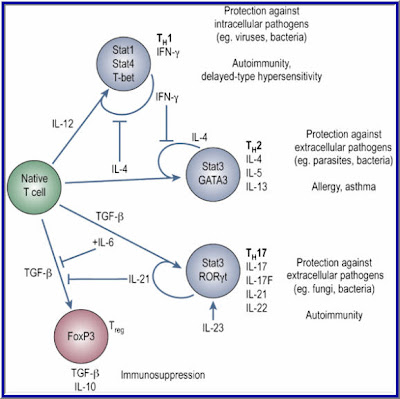


FROM:
Autoimmunity: IL-21: a new player in Th17-cell differentiation
Elissa K Deenick and Stuart G Tangye
WWW.Nature.com

Ribas and Restifo et al found that if you use Anti-CTLA-4 blockade the native T-cell is pushed towards the Th17 differentiation. This causes less interleukin-2 to be produced by the CD4+ T-cells causing a shortage of IL-2 in the microenvironment for the expanding T-cells thus limiting the differentiation to Tregs. It is well known that in the presence of TGF-beta and IL-2, the Native T-cell differentiates into T Regulatory Cells.

Also the activation and differentiation of Naïve CD8+ T cells require IL-2 provided by activated CD4+ T cells at the initial priming stage within 0–2.5 hours after stimulation. Thers is
critical IL-2 signal from CD4+ cells is mediated through the IL-2R (receptor) of Naïve CD8+ cells. This activation of IL-2 signaling advances the restriction point of the cell cycle, and thereby expedites the entry of antigen-stimulated Naïve CD8+ T-cell into the S phase of the cell cycle.

The cell cycle has four stages:

1. G1 phase when the cell increases in size and gets ready to replicate its DNA.
2. S phase when the cell synthesizes or copies its chromosomes
3. G2 phase in which the cell prepares to divide
4. M phase when mitosis occurs.

If no IL-2 is available to Naïve CD8+ T-cells, they never get a chance to expand and differentiate into Cytotoxic T Lymphocytes (CTLs) Killer T-cells.
Besides promoting cell proliferation, IL-2 stimulation increases the amount of IFNγ and granzyme B produced by CD8+ T cells.

Activation and Differentiation of (CTLs) Cytotoxic T Lymphocytes

Naïve CD8+ T-cells are referred to as CTL-precursors (CTL-Ps), which are incapable of performing any function other then recognizing the class I MHC-antigen complex on the Tumor cells through the (TCR) T Cell Receptor.

For activation, the CTL-P needs at least three signals:

1. Antigen specific signal transmitted by the MHC I peptide/TCR complex for the recognition of the Antigen

2. The Costimulatory signals transmitted by the CD28 receptor and the B7 molecule of the Antigen Presenting Cells (APCs)

3. Cytokine induced signal, IL-2 interaction with the IL-2r (receptor) on the CTL-P leading to activation and differentiation of the CTL-P into effector CTL

The Cytokine IL-2 came from the(CD4+) TH1 cells which means the CTL-P is IL-2 limited and can only be activated by the secreted IL-2 if there is any to be had or by introducing IL-2 through IL-2 therapy. Now you know the reasoning behind using the IL-2 therapy as the second part of the combinatorial Therapy. If there is not enough IL-2 in the host environment, you will only get partial expansion of the CTLs. It may not be enough to eradicate large bulky tumors.

The Interluekin-2 plays another role in this Melanoma Maze. In a study by Janas et al, Il-2 increases the expressions of the perforin and granzyme A, B and C genes in the CD8+ T-cells. This increase expression causes the CD8+ T-cells to mature into Cytoxic T Lymphocytes (CTLs). The exogenous IL-2 is required for the granzyme proteins. CTLs have cytoplasmic granules that contain the proteins perforin and granzymes. A dozen or more perforin molecules insert themselves into the plasma membrane of target cells forming a pore that enables granzymes to enter the cell. Once in the tumor cell, these enzymes are able to breakup (lyse) the cell and destroy it. This is the beginning of the end for the cancer cells. The tumors begin to shrink and the rest is history.

Research suggests that the primary mode of the destruction of the tumors by CTL is by initiating death through the Fas-FasL pathway. Studies have shown that CTLs store Cytotoxic proteins in the form of granules in their cytoplasm.

These proteins belong to two categories:


1. Perforins: involved in pore formation
2. Granzymes: responsible for hydrolysis of the cellular products.

Granzymes breaks down the tumors cells just like your detergent enzymes in your laundry detergent.

Immediately following a CTL contact with the tumor cell, the Golgi sacks load with granules and granzymes which create pores to allow the granzymes to enter and destroy the tumors cells.

So now you know why Anti-CTLA-4 blockage and HD Interluekin-2 go hand and hand. Timing of the addition of IL-2 can make or break the immune response. And without suppressing the Tregs, your chances to mount an immune response may be slim at best. Your Immune System is a well Orchestrated system of events; we just need the Knowledge on how to harvest its potential on eradicating cancer.


The beginning of knowledge is the discovery of something we do not understand.
~Frank Hebert~
A critically acclaimed and commercially successful American science fiction author


Take Care,

Jimmy B
Photobucket

Wednesday, March 17, 2010

The Making of an Immune Response by Combinatorial Therapy Using Anti-CTLA-4 Blockade and Interleukin-2..Melanoma..Jim Breitfeller

The Making of an Immune Response by Combinatorial Therapy Using Anti-CTLA-4 Blockade and Interleukin-2

The paper that I am about to present to you is a culmination of research that was done base on my own experience as a stage IV Melanoma Patient. I wanted to know why my immune system responded and prove to myself and my doctors that it was not a statistical fluke. I dedicate this paper to all my fellow Melanoma Patients that lost their battle with the Beast, especially Bob Luker who fought so bravely but was unable to obtain Anti-CTLA-4 blockade due to the shortage proclaimed by Bristol Myer Squibb which halted compassionate drug use on 9-12-2008.

Most Melanoma tumors are accepted by the host’s immune system and progress even when they contain potentially antigenic proteins. This may be due to the tumor secreting immunosuppressive Cytokines like, TGF-Beta, IL-10, IL-4 and IL-6. TGF-β inhibits the proliferation and functional differentiation of T lymphocytes. TGF- Beta accelerates the expression of CTLA-4 by stimulated CD4+CD25– T cells. TGF- Beta requires CTLA-4 early after T Cell Activation to induce FoxP3 and generates adaptive CD4+CD25+ (Treg) Regulatory Cells. The tumor cells secrete TGF-Beta.

The Making of an Immune Response by Combinatorial Therapy Using Anti-CTLA-4 Blockade and Interleukin-2


Take Care,

Jimmy B
Photobucket

Friday, August 28, 2009

Is Triple Therapy more effective than Single Agent Therapy? Melanoma..Jim Breitfeller

Is Triple Therapy more effective than Single Agent Therapy?

Base on my knowledge there are at least five things you need to accomplish before an immune response can be generated:

1. You need the correct antigen to be presented by the (APC) Antigen presenting cell at the TCR T Cell receptor
2. You need to Activate the CD-4 + T-cell
3. You need to co-stimulate the CD28 receptor
4. You need to suppress the Treg cells
5. You need to a growth factor (IL-2) to grow your army of Cytotoxic Cells

Once activated, you need all the players to help orchestrate the immune response. This can not be done by single agent alone. The immune response has checks and balances that it must pass through. It is like opening a deposit box at the bank. You need the master key to open the first gate. Then you need two different keys to gain access to the deposit box. Plus there is a sequence of events that must be followed to gain access. If you only have one key, you will fail to open the box.

Each Drug company has a key to solving the problem. In order to get the tumor specific response the drug companies must work together.
Photobucket


Take Care,

Jimmy B
Photobucket

Thursday, April 9, 2009

Signs, signs everywhere there are signs!!!! Melanoma ..Jim Breitfeller

"Depletion of TREG cells using CD25-specific (mAbs) monoclonal antibodies has been shown to promote rejection of several transplantable murine tumour cell lines, including melanoma, fibrosarcoma, leukaemia and colorectal carcinoma. These studies imply that TREG cells normally inhibit the generation of effective T cell-dependent anti-tumour immune responses. These finding have been confirmed in the clinical setting, where the prevalence of TREG cells was found to be increased in the peripheral blood and tumour microenvironment of cancer patients."

We just need to break the imbalance and generate an immune response.


"IL-2 has been shown to be essential for the generation of TREG cells in the thymus and their survival, expansion and suppressive function in
the periphery [69]. IL-2-, and IL-2R-deficient mice develop T-cell lympho-proliferation and lethal autoimmunity, very probably due to lack of
activation-induced cell death (AICD) and lack of T REG cells. Furthermore, in vivo IL-2 neutralisation by use of an IL-2 blocking antibody also induces autoimmune diseases in mice. The detailed molecular mechanisms of the effects of IL-2 in the homeostasis and suppressive function of TREG cells have still to be clarified."

Source:http://www.smw.ch/docs/pdf200x/2007/45/smw-11916.PDF

"CD4+CD25+Foxp3+ regulatory T cells: frombasic research to potential therapeutic use"

Christian Motteta, Dela Golshayanb
a Division of Gastroenterology & Hepatology, BH-10N-545, Centre Hospitalier Universitaire
Vaudois (CHUV), Lausanne, Switzerland
b Division of Nephrology & Transplantation Centre, Centre Hospitalier Universitaire Vaudois
(CHUV), Lausanne, Switzerland

Take care


Jimmy B

Monday, March 30, 2009

Synergism of anti-CTLA-4 Blockage & Depletion of CD25 Tregs Cells Melanoma.. Jim Breitfeller

Synergism of Cytotoxic T Lymphocyte–associated Antigen 4
Blockade and Depletion of CD25 Regulatory T Cells in
Antitumor Therapy Reveals Alternative Pathways for Suppression of Autoreactive Cytotoxic T Lymphocyte (CTL) Responses

Roger P.M. Sutmuller,1 Leonie M. van Duivenvoorde,1 Andrea van Elsas,1
Ton N.M. Schumacher,2Manon E. Wildenberg,1James P. Allison,3 Rene E.M.Toes,1 Rienk Offringa,1 and Cornelis J.M. Melief 1

1 Department of Immunohematology and Blood Transfusion, Tumor Immunology Lab, E3-Q, Leiden
University Medical Center, 2300 RC Leiden, Netherland

2Division of Immunology, The Netherlands Cancer Institute, 1066 CX Amsterdam, Netherlands

3 Howard Hughes Medical Research Institute, Cancer Research Laboratory, Department of Molecular and Cellular Biology, University of California at Berkeley, Berkeley, CA 94720

Abstract:

Therapeutic efficacy of a tumor cell–based vaccine against experimental B16 melanoma requires the disruption of either of two immunoregulatory mechanisms that control autoreactive T cell responses: the cytotoxic T lymphocyte–associated antigen (CTLA)-4 pathway or the
CD25+ regulatory T (Treg) cells. Combination of CTLA-4 blockade and depletion of CD25+ Treg cells results in maximal tumor rejection. Efficacy of the antitumor therapy correlates with the extent of autoimmune skin depigmentation as well as with the frequency of tyrosinaserelated protein 2 180–188 –specific CTLs detected in the periphery. Furthermore, tumor rejection is dependent on the CD8+ T cell subset. Our data demonstrate that the CTL response against melanoma antigens is an important component of the therapeutic antitumor response and that the reactivity of these CTLs can be augmented through interference with immunoregulatory mechanisms. The synergism in the effects of CTLA-4 blockade and depletion of CD25+ Treg cells indicates that CD25+ Treg cells and CTLA-4 signaling represent two alternative pathways for suppression of autoreactive T cell immunity. Simultaneous intervention with both ris therefore a promising concept for the induction of therapeutic antitumor immunity."

I contacted Dr. Roger P.M. Sutmuller from the Netherlands because I knew that in My therapy, I somehow overcame the T-Reg cells that surpress the immune response. In his research, he and colleagues had found out that if you deplete the T-Regs, it enhanced the immune response. So I took this one step further and noticed that if you delayed the addition of IL-2 after the CD4+T cell activation, we also overcame the Treg supression. The is due to a Novel Mechanism call Indexation. The Tregs (CD4+CD25+ Regulatory T cells) are indexed to the number of IL-2 producing cells. This Means that their proagation is tied to the secretion of IL-2 during the expansion of the CD4+ T cells. IL-2 is the rate limiting factor. So if you delay the addition of IL-2, then you contol the Tregs.
Neat!!!!!!

So Lets go back to The infamous Chart.
Photobucket

In the bottom chart you can see the IL-2 addition took place at the CD8+ T cell maximum propagation not at the cd4+ T-cell Maximum. So we controlled the propagation of the T Regs and in the process helped the CD4+,CD8+ activation to generate the Immune response.


Jimmy B

Greetings to One and All

This Blog is dedicated My Brother Kenny B. who passed away in the late 1970's with Cancer before the Internet.

It was he, who showed me How to live and give back. He was wise beyond his years.


Kenny B


Jimmy and Dee

Carepage: Jimmybreitfeller
Jimmy Breitfeller


My Profile as of 2009

My photo
Last July (2005)I was riding my bicycle to work at the Eastman Kodak Research Labs about 3 miles from home. I was wearing a knapsack to carry my things to and from the labs. I started noticing an ache on my back. So I decide to go to the dermatologist. To make the long story short, it was cancer. I knew from my research that I would be needing adjuvant therapy. So I started communicating with Sloan Kettering, University of Pittsburgh Cancer Center, and a couple of others including the Wilmot Cancer Center at Strong. I realized that by telling my story, I might help someone else out there in a similar situation. So to all who are linked by diagnosis or by relation to someone with melanoma, I wish you well. Stay positive, read as much as you can (information helps to eliminate the fear associated with the unknown), and live for today, as no one can predict what tomorrow may bring. Jimmy B. posted 12/15/08

Disclaimer

The information contained within this Blog is not meant to replace the examination or advice of your Oncologist or Medical Team. The educational material that is covered here or Linked to, does not cover every detail of each disorder discussed.

Only your physician/Oncologist can make medical decisions and treatment plans that are appropriate for you. But, An Educated Consumer is a Smart consumer.

As Dr. Casey Culberson Said:

"The BEST melanoma patient is an ACTIVE PARTICIPANT in his or her treatment
(not a PASSIVE RECIPIENT)"

Melanoma and the “Magic Bullet” (Monoclonal Antibodies)

Just to let you know I posted the first draft of the Melanoma and the “Magic Bullet” (Monoclonal Antibodies). on Melanoma Missionary In the Shared File Section. you can download it for 19.95 (Only kidding) it is Free for the taking.


It is 33 pages long and may help you in your quest for the Yellow Brick Broad. Just to let you know it is only the first draft. Revisions are sure to come. I wanted to get it to the people that need it the most, the Melanoma Patients.

Preview:

So, where does Interluekin-2 (IL-2) come into play? According to Byung-Scok et al and recent reports, IL-2 is not needed for developmental CD4+ CD25+ Treg cells in the thymus but does play an important role in the maintenance and function in the peripheral.18 Peripheral is defines as secondary system outside the bone marrow and thymus. It entails the site of antigen, immune system interaction. IL-2 is required for the peripheral generation of Tregs based Abbas’s and colleagues research.19

IL-2 prevents the spontaneous apoptosis of the CD4+ CD25+ Treg cells. It has been reported that patients with multiple advance-stage tumors have elevated levels of Tregs within the tumor microenviroment.20 Interluekin-2 is the survival factor for CD4+ CD25+ Treg cells.21 If the addition of IL-2 is on or before the maximum propagation of the CD4+ T cells, the Tregs population can increase 5-fold in a 96 hour period based on certain growth mediums.

By controlling the addition of the endogenous IL-2, one has a knob to turn and can lead to the control of the expansion of the Tregs. When you combined this control with the anti-CTLA-4 blockage, you can shift the balance of the immune response.

Now here is the catch. The maintenance and function of the CD8+ T-cells require CD4+ cells which secrete IL-2. So we don’t want to deplete the CD4+ cells, we want to control the expansion of the Tregs which are a subset of the CD4+ cells. It has been postulated by some researchers that the Anti-CTLA-4 blockage also suppresses the Treg function in a different mechanism. By using IL-2 as the rate limiting factor, we can suppress the CD4+ CD25+ Treg cell expansion by controlling the concentration and timing of the Inerluekin-2 at the tumor microenvironment.


The Interluekin-2 plays another role in this Melanoma Maze. In a study by Janas et al, Il-2 increases the expressions of the perforin and granzyme A, B and C genes in the CD8+ T-cells. This increase expression causes the CD8+ T-cells to mature into Cytoxic T Lymphocytes (CTLs). The exogenous IL-2 is required for the granzyme proteins. As stated previously, CTLs have cytoplasmic granules that contain the proteins perforin and granzymes. A dozen or more perforin molecules insert themselves into the plasma membrane of target cells forming a pore that enables granzymes to enter the cell. Once in the tumor cell, these enzymes are able to breakup (lyse) the cell and destroy it. This is the beginning of the end for the cancer cells. The tumors begin to shrink and the rest is history,


On the other hand, prolong therapy with Il-2 can result in causing apoptotic death of the tumor- specific CD8+ T-cells.23

Clearly in a clinical setting, timing, dose, and exposure to these drugs play a major roll in the immunotherapy, and can have dramatic effects on the outcome.

All it takes is that one magic bullet to start the immune reaction..

https://app.box.com/shared/kjgr6dkztj

Melanoma And The Magic Bullet (Monoclonal Antibodies)

Public Service Announcement

A call for Melanoma Patients by Dr. Steven A Rosenberg

"We continue to see a high rate of clinical responses in our cell transfer immunotherapy treatments for patients with metastatic melanoma", Dr. Rosenberg said.

"We are actively seeking patients for these trials and any note of that on a patient-directed web site would be appreciated."

If you would like to apply for his trials, here is the website and information.

Dr. Rosenberg's information


Dr. Rosenberg's Clinical Trials


For the Warriors


The Melanoma Research Alliance has partnered with Bruce Springsteen, the E Street Band, and the Federici family to alleviate suffering and death from melanoma. Please view Bruce Springsteen’s public service announcement inspired by Danny Federici. Danny was the E Street Band’s organist and keyboard player. He died on April 17, 2008 at Memorial Sloan-Kettering Cancer Center in New York City after a three year battle with melanoma.


http://www.melanomaresearchalliance.org/news/PSA/

Source Fastcures blog


Join the Relay for Life!!!

Photobucket

Dear Family and Friends,

I’ve decided to take a stand and fight back against cancer by participating in the American Cancer Society Relay For Life® event right here in my community! Please support me in this important cause by making a secure, tax-deductible donation online using the link below.

To donate on line now, click here to visit my personal page.
Jimmy B AKA Melanoma_Missionary

Relay For Life® is a life-changing event that brings together more than 3.5 million people worldwide to:

CELEBRATE the lives of those who have battled cancer. The strength of survivors inspires others to continue to fight.

REMEMBER loved ones lost to the disease. At Relay, people who have walked alongside people battling cancer can grieve and find healing.

FIGHT BACK. We Relay because we have been touched by cancer and desperately want to put an end to the disease.

Whatever you can give will help - it all adds up! I greatly appreciate your support and will keep you posted on my progress.

Keep the Fire Burning!!!

Photobucket

Sincerely,

Jimmy Breitfeller
Turn off Music before you "Click to Play"
Signs of Melanoma Carcinoma Skin Cancer

How Skin Cancer Develops by "About.com : Dermatology"

Call for Patients with Unresectable Liver Metastases Due to Melanoma


Delcath Systems Granted Orphan-Drug Designations for Cutaneous and Ocular Melanoma


Delcath is actively enrolling patients in a Phase III clinical trial testing its proprietary drug delivery system, known as Percutaneous Hepatic Perfusion (“PHP”), with melphalan for the treatment of ocular and cutaneous melanoma metastatic to the liver.

This NCI-led trial is enrolling patients at leading cancer centers throughout the United States. Commenting on these orphan-drug designations, Richard L. Taney, President and CEO of Delcath, stated, “These favorable designations are important steps in our efforts to secure Delcath’s commercial position upon conclusion of our pivotal Phase III trial for metastatic melanoma. We remain steadfast in our commitment to become the leader in the regional treatment of liver cancers and we continue to enroll patients in this study, and advance our technology and the promise that it offers to patients with these deadly forms of melanoma and other cancers of the liver, all with limited treatment options.”

Orphan drug designation, when granted by the FDA’s Office of Orphan Products Development, allows for up to seven years of market exclusivity upon FDA approval, as well as clinical study incentives, study design assistance, waivers of certain FDA user fees, and potential tax credits.


Current Trial Centers


Phase I Study of Hepatic Arterial Melphalan Infusion and Hepatic Venous Hemofiltration Using
Percutaneously Placed Catheters in Patients With Unresectable Hepatic Malignancies


James F. Pingpank, Jr., MD, FACS
Associate Professor of Surgery
Division of Surgical Oncology
Suite 406, UPMC Cancer Pavillion
5150 Centre Avenue
Pittsburgh, PA 15232
412-692-2852 (Office)
412-692-2520 (Fax)
PingpankJF@UPMC.edu


Blog Archive

Call For Melanoma Patients!!!!

Call For Melanoma Patients!!!!

Dr. Rosenberg Has a New Clinical Trial.

Our latest treatment has a 72% objective response rate with 36% complete responses.

We are currently recruiting patients for our latest trial.

Is there some way to post this “Call for Patients” on the web site?

Steve Rosenberg

Dr. Rosenberg's Clinical Trials


(For a copy of the research paper.. see My Shared files)

The news headlines shown above for Melanoma / Skin Cancer are provided courtesy of Medical News Today.